Today's Monster Monday is the arachnocalliope, a mad construct that is like a magical cross between a spider and a pipe organ. Piping atonal, demoralizing notes with every movement of its many brass legs and every contraction of its armored bellows-abdomen, the arachnocalliope is a true visual and aural horror.
This eccentric contraption functions as a sort of anti-bard in combat, laying down de-buffs on its enemies with sonic effects. Not that it is helpless on its own, with two sword-like forelegs and a sonic breath weapon (no one is resistant to sonic damage!).
The genesis of this creature lies in my Graverobbers campaign (which I have not posted an update on in about 3 years, but it's still going). In one session, the players were fighting some constructs made by a creative witch whose chosen artistic medium was bone sculpture. Among the odd bone creations they fought was this arachnocalliope. I decided it worked pretty well as its own stand-alone monster, so I re-worked it a bit to be made out of normal materials and here we are. Some of those other bone creations, like the ballistocentaur and the triskeliettin may make an appearance here in the future, but for now you'll just have to use your imagination to wonder what those polysyllabic monstrosities might be.
The following text in gold is available as Open Game Content under the OGL. Open Game Content is ©2018 Jonah Bomgaars.

Showing posts with label CR 4-6. Show all posts
Showing posts with label CR 4-6. Show all posts
Monday, September 24, 2018

Monday, August 13, 2018
Monster Monday: Chordopod, Bony Tentacle Beast
Today's Monster Monday is the chordopod, an undead monstrosity that takes the rough form of an octopus or spider made of bones. At its center is a large skull-shaped head formed from twisted and distorted bones, while its many tentacles or legs are long spinal columns which whip and curl and crawl. This twisted undead abomination is the result of a great outpouring of negative energy in places such as mass graves, battlefields, and shipwrecks where the remains of many individuals are left to mingle and decay anonymously.
With the ability to burrow, climb, and swim, these nimble monstrosities are all-terrain foes (I guess you're safe in the sky, unless one of them grabs onto the hull of your airship as you are taking off). I can see them bursting out of the desert sand just as easily as I can see them bursting out of the storm-wracked ocean or bursting through the troubled earth of a bloody battlefield. I guess I just picture them bursting through things.
Also in the stat-block below, a diseased variant that rises from the mass graves of plague victims and stalks through the streets of disease-wracked cities or the pestilential countryside, spreading filth and rot in their wake.
The following text in gold is available as Open Game Content under the OGL. Open Game Content is ©2018 Jonah Bomgaars.
With the ability to burrow, climb, and swim, these nimble monstrosities are all-terrain foes (I guess you're safe in the sky, unless one of them grabs onto the hull of your airship as you are taking off). I can see them bursting out of the desert sand just as easily as I can see them bursting out of the storm-wracked ocean or bursting through the troubled earth of a bloody battlefield. I guess I just picture them bursting through things.
Also in the stat-block below, a diseased variant that rises from the mass graves of plague victims and stalks through the streets of disease-wracked cities or the pestilential countryside, spreading filth and rot in their wake.
The following text in gold is available as Open Game Content under the OGL. Open Game Content is ©2018 Jonah Bomgaars.
Monday, August 6, 2018
Monster Monday: Ammonites - Spiral-Shelled Cephalopods of Prehistoric Seas
Today's Monster Monday is the ammonite, a hard-shelled nautilus-like creature that floated through the prehistoric seas for some 350 million years before being wiped out in the same extinction that ended the age of the dinosaurs.
Ammonites typically had a spiral shell made up of successively smaller chambers that they could flood with gas or water to control their buoyancy. The animal itself was a cephalopod, probably ten-armed, which protruded from the end of the shell. Some ammonites may have been able to withdraw into their shells like a modern nautilus or a snail. Some may have had ink they could release in a cloud like modern squid and octopuses. But when we are talking about ammonites, we are talking about thousands of species across hundreds of millions of years - there was room for plenty of variation. Some - like the nostoceratidae - had irregularly unwound shells and probably floated through the sea like plankton or jellyfish. Some just crawled along the sea floor. Most ammonites were small, with shell spirals reaching no larger than 9 inches in diameter. But the two types of ammonites we will be looking at today were big.
Titanites giganteus did not let the ocean currents decide where it would go, as if it were some kind of overgrown plankton. No, titanites was a swift hunter, jetting through the ocean in search of prey it could wrap its probing tentacles around and gnaw with its sharp beak. Their shells reached 2-3 feet in diameter, much larger than the typical ammonite of its day. But even the bigly named titanites giganteus was dwarfed by:
Parapuzosia seppenradensis may be a mouthful of a name, but you would be hard pressed to find a predator capable of making this ammonite into a mouthful. The 5.9 foot diameter fossil seen above is broken - with its intact living chamber, estimates put this specimen at 8.4 to 11 feet in diameter, making it by far the largest ammonite species. In life, the creature may have weighed 3,200 pounds, fully half of which comes from its massive shell. If parapuzosia was a hunter like titanites was, it must have been an impressive and terrifying sight to behold.
The following text in gold is available as Open Game Content under the OGL. Open Game Content is ©2018 Jonah Bomgaars.
Ammonites typically had a spiral shell made up of successively smaller chambers that they could flood with gas or water to control their buoyancy. The animal itself was a cephalopod, probably ten-armed, which protruded from the end of the shell. Some ammonites may have been able to withdraw into their shells like a modern nautilus or a snail. Some may have had ink they could release in a cloud like modern squid and octopuses. But when we are talking about ammonites, we are talking about thousands of species across hundreds of millions of years - there was room for plenty of variation. Some - like the nostoceratidae - had irregularly unwound shells and probably floated through the sea like plankton or jellyfish. Some just crawled along the sea floor. Most ammonites were small, with shell spirals reaching no larger than 9 inches in diameter. But the two types of ammonites we will be looking at today were big.
 |
photo by Ghedoghedo, via Wikimedia
Titanites giganteus - Natural History Museum, London |

 |
photo via Wikimedia
German zoologist Hermann Landois sitting next to his fossil of Parapuzosia seppenradensis, with a wire frame showing the projected size if the specimen were complete. |
.jpg)
The following text in gold is available as Open Game Content under the OGL. Open Game Content is ©2018 Jonah Bomgaars.
Monday, July 30, 2018
Monster Monday: Tomtenisse - Tiny Fey that Pack a Punch
Today's Monster Monday is the tomtenisse, also known as tomte, nisse, or tonttu, an apple-sized little gnome from Scandinavian folklore which acts as a guardian spirit for a plot of land. These little guys have incredible strength for their size, able to punch out a grown man, snap a cow's neck, or carry a one ton load above their head. Why would these helpful farm spirits ever punch a cow to death? Well, tomtenisse can also be pretty dang ornery.
Tomtenisse help out around the farm in unseen ways, mending things, tending to the animals, and carrying loads. All they want in return is a bowl of porridge with a pat of butter on it on a specific day. If they don't get their porridge, they can become enraged, breaking things and lashing out at nearby creatures to punish their lax master. The older the tomtenisse, the more particular it gets about how a farm is run, and the quicker it is to inflict corporal punishment. If a new farmer on the land starts putting his tools away in the wrong places, a young nisse might rearrange them all in the night or pile them against the farmer's bedroom door, while an older nisse might simply break every tool that is out of its place. If a farmhand urinates in the barn, they might grab a manure shovel and smack them in the back of the head. If someone eats the nisse's porridge, they will usually be found beaten to within an inch of their life.
In perhaps the most illustrative story of the tomtenisse, a farmer leaves the nisse his usual bowl of porridge, but accidentally puts the butter on the bottom of the porridge. The nisse, thinking the farmer forgot the butter, becomes so enraged that he leaps up and cracks the neck of the farmer's prized cow. He then eats the porridge and finds the pat of butter at the bottom. Remorseful, the nisse runs to all the neighboring farms until he finds an identical cow to bring back for the farmer.
The tomtenisse reserve their deadliest weapon for those who cross them severely: a nisse bite can leave its victim cursed to wither away and die.
The tomtenisse legend may come from a pre-Christian belief in ancestor spirits. The earliest tomtenisse lived in burial mounds, perhaps the spirit of the first farmer to clear and work the land. In the 14th century, Saint Birgitte of Vadstena warned people not to worship the tompta gudhi (the house-lot gods). In modern times, the tomtenisse remain popular as Christmas figures, and though tales remain of angry nisse beating people to a pulp, they are more commonly seen having seasonal fun on Christmas cards.
The following text in gold is available as Open Game Content under the OGL. Open Game Content is ©2018 Jonah Bomgaars.
 |
| In the Christmas Night by John Bauer (1913), via Wikimedia |

In perhaps the most illustrative story of the tomtenisse, a farmer leaves the nisse his usual bowl of porridge, but accidentally puts the butter on the bottom of the porridge. The nisse, thinking the farmer forgot the butter, becomes so enraged that he leaps up and cracks the neck of the farmer's prized cow. He then eats the porridge and finds the pat of butter at the bottom. Remorseful, the nisse runs to all the neighboring farms until he finds an identical cow to bring back for the farmer.
The tomtenisse reserve their deadliest weapon for those who cross them severely: a nisse bite can leave its victim cursed to wither away and die.
The tomtenisse legend may come from a pre-Christian belief in ancestor spirits. The earliest tomtenisse lived in burial mounds, perhaps the spirit of the first farmer to clear and work the land. In the 14th century, Saint Birgitte of Vadstena warned people not to worship the tompta gudhi (the house-lot gods). In modern times, the tomtenisse remain popular as Christmas figures, and though tales remain of angry nisse beating people to a pulp, they are more commonly seen having seasonal fun on Christmas cards.
The following text in gold is available as Open Game Content under the OGL. Open Game Content is ©2018 Jonah Bomgaars.
Monday, July 23, 2018
Monster Monday: Xiuhcoatl, Aztec Fire Serpent
Today's Monster Monday is the xiuhcoatl, a fire serpent from Aztec mythology. This serpentine dragon has turquoise. Waves of heat ripple around it as it vents steam and breathes fire. When angered, it can charge with lightning speed, striking its target with an explosion of fiery force.
In Aztec mythology, the god Huitzilopochtli used his atlatl to throw xiuhcoatl like lightning-bolt javelin. It was how he killed his sister Coyalxauhqui when she led the Southern Star Gods to war against their pregnant mother. Xiucoatl was also a form of Xiuhtecuhtli - the Turquoise Lord - Aztec god of fire. Xiuhcoatl is the lightning bolt that starts a brushfire in the grasslands, the fire that rains out of a volcanic eruption, and the heat of the sun in the dry season.
The following text in gold is available as Open Game Content under the OGL. Open Game Content is ©2018 Jonah Bomgaars.
 |
| Xiuhcoatl sculpture at the British Museum (author's photo) |
The following text in gold is available as Open Game Content under the OGL. Open Game Content is ©2018 Jonah Bomgaars.
Monday, July 2, 2018
Monster Monday: Armored Grave - This Armor Shall Serve as My Epitaph
Today's Monster Monday is the armored grave, a knight buried in his armor, its once-gleaming plates now bursting at the seams with hard-packed grave dirt and the putrescence of decay. These are the tanks of the low-level undead world.
 Buried in their armor, these ritually-prepared undead take on a new body of hard-packed grave dirt, granting them an additional layer of protection. Compared to ordinary skeletons and zombies, armored graves are invulnerable, unstoppable death machines.
Just to kick things up a notch, an armored epitaph is a slightly stronger armored grave which has Intelligence and feats and which isn't staggered.
The following text in gold is available as Open Game Content under the OGL. Open Game Content is ©2018 Jonah Bomgaars.

Just to kick things up a notch, an armored epitaph is a slightly stronger armored grave which has Intelligence and feats and which isn't staggered.
The following text in gold is available as Open Game Content under the OGL. Open Game Content is ©2018 Jonah Bomgaars.
Monday, April 23, 2018
Monster Monday: Mummy Wraps - The Embalming Construct
I approached the door with some trepidation, my earlier discourse with M. H-- on the subject of curses weighing heavily on my fevered mind. As a man of science, I held myself above such superstitions, but in that dark sandstone tunnel, choked with the dust of ages, such things seemed terrifyingly possible. Cuvier beckoned me examine the inscription on the door. Those inscrutable hieroglyphs remain a mystery to me, and I truly have no idea how my companion, learned though he was in such things, and quite more well-endowed with critical faculties than I, was able to derive meaning from them. Nevertheless, he did his best to explain. 'The room beyond must be the embalming chamber. Therein, the cadaver was prepared for the afterlife by the removal of the organs and the preservation of the flesh.'Today's Monster Monday is mummy wraps, a dangerous construct that takes the form of spell-inscribed linen bandages with the power to wrap themselves around their victims, embalming them and turning them into mummies. While the victim's companions are presumably trying to figure out how to hit the bandages without harming their friend, the mummy wraps can control their cohort like a puppet, attacking them with their body as the victim watches helplessly.
This gruesome fact was not new to me. I had, of course, read the MS by the renowned Mr. B-- of the Royal Society on the details of the process, which I have already laid out for you in great detail earlier in my account. But the idea that this place of ritual disemboweling lay just ahead of me through a foot of crumbling stone was, at the time, most disconcerting to my temper. Pallid though I was already, I am certain I grew more so at this news, though good Cuvier either did not notice or was kind enough not to remark upon it.
Cuvier bade the workers make use of the great prybars which they had brought along for that purpose, and within the hour they had shifted the stone aside enough that we could make our ingress. Cuvier insisted on going first, and to my great and ongoing regret I let him do so with no small measure of relief on my part. He cast the light of his hooded lantern around the room, revealing what to the ancients must have been an impressive laboratory. Jars full of chemicals and unguents stood intact in chests of desiccated wood. An array of tools, equally at home in the hands of an anatomist as in those of a torturer, glinted in the light as if they were new, the dry desert air having preserved them for thousands of years without rust or decay. But in the middle of that cursed room - and I say cursed now, with full confidence and the benefit of hindsight - stood a solid stone mortuary slab topped with a tangle of ancient linen bandages. O that we had taken our leave then! But no.
Fancying that I spied a scrap of writing on the bandages and fearing that my hands, moist from the fever and - I must admit - from nerves, might damage any ancient ink, I motioned Cuvier to take a closer look. When he did - O! If only this truly had been a fever dream! - the bandages rose up of their own accord and wrapped themselves around him. Helpless before these twining snakes of fabric, Cuvier at first stared in wonder, then tried to scream. His aborted scream, cut off by the living bandages as they covered his mouth, still chills me to my very core. With his last ounce of will, my dear companion reached out a shaking hand in a silent plea for help, but before I could grasp it, the bandages tightened and forced his arms to his sides. Before my very eyes, his skin grew brittle and taut and deathly dry. I could not help but turn away and, in my cowardice, flee headlong into the night.
I know not how I made it out of that warren of ancient tunnels, the workers long since having fled and my only light source lying abandoned on the ground at the feet of my dead friend. Perhaps the instinct for survival alone carried my tired body back to my apartment on K-- Street. I can tell you that I did not sleep at all that night, as my thoughts were focused entirely on the arrangements I must make to leave this benighted country on the morrow. The full horror and the burden of guilt did not wash over me until that dark hour which lurks in the shadowy spaces between midnight and dawn. Alone with only my thoughts, I fancied that I perceived a dull scratching on my chamber door. I attempted to dispel the notion, but the sound grew only more persistent, its terrifying reality intruding even on my fevered and terror-stricken mind. At last, in a misplaced attempt to assuage my fears, I went to the door and opened it.
There stood Cuvier, wrapped in those ancient linens, his skin browned with naptha and pulled tight across his bones. It is his face that still haunts me - cracked and sunken, with hollow eye sockets that could only be sightless and yet seemed so terribly perceptive. His papery lips pulled back into an accusing sneer, revealing yellowed teeth and a black tongue. I slammed shut the door immediately, and pushed my steamer trunk in front of it as a barricade. The scratching at the door came again in earnest, quickly becoming an insistent rap, and then a pounding that echoed in my ears. Abandoning my earthly possessions, I made my egress through the shuttered window and went by barge that very night to the port, with the intent of catching a ship bound northward at first light.
I write this account from within the walls of St. S-- Asylum for the Criminally Insane, in the hopes that someone might read my words and know that, while I did not kill Dr. August Cuvier, I most certainly do not hold myself blameless in the story of his death. If his mummified body is ever recovered, I pray that whosoever finds it has the sense not to touch the bandages.
The above vignette is written in the style of Edgar Allan Poe, albeit with fewer wordy and tortuous digressions on substitution ciphers, the value of inference, and the details of 19th century Parisian police-work. Don't ask me why, it just seemed fitting. Call it a tribute to my first DM, who kept a volume of the complete works of Poe on his shelf and insisted that it was "good fucking literature for Dungeon Masters."
The following text in gold is available as Open Game Content under the OGL. Open Game Content is ©2018 Jonah Bomgaars.
Monday, March 19, 2018
Dawn of the Plane of the Apes: Gigantopithecus, Dire Ape
Today's Monster Monday is part III of our month-long series about apes. This week, we're looking at the dire ape, or gigantopithecus. Gigantopithecus stood nearly 10 feet tall at full extension, making it a gigantic hulk of an ape. Older depictions of gigantopithecus often make it look like a giant gorilla, but the closest living relative of this giant Asian ape is actually the orangutan.
We don't have a lot of fossils of gigantopithecus - mostly teeth from caves in China, India, and Vietnam. One thing missing are its pelvic bones, so we don't know for sure whether it walked upright like a human or on all fours like most apes. Given its bulk and the rarity of upright locomotion, it seems most likely that it used its arms and legs to walk, like a gorilla. But that hasn't stopped cryptozoologists from speculating (unfounded speculation is what they do, after all) that relic populations of gigantopithecus are responsible for sightings of sasquatches and yeti. That is, of course, dumb, but it is a gigantopithecus fun fact.
Since I reworked chimpanzees, orangutans, and gorillas, I had to rework the dire ape as well. As previously statted up, the dire ape was a CR 3 monster with 19 Strength. That would make them less powerful than my gorillas. Heck, it puts this giant ape roughly on par with a walrus. So the new dire ape is a CR 6 monster with 23 Strength. It has two slams, a bite attack, and rend. In combat, the gigantopithecus will bring its incredible strength to bear on any attackers, rending them limb from limb.
The following text in gold is available as Open Game Content under the OGL. Open Game Content is ©2018 Jonah Bomgaars.
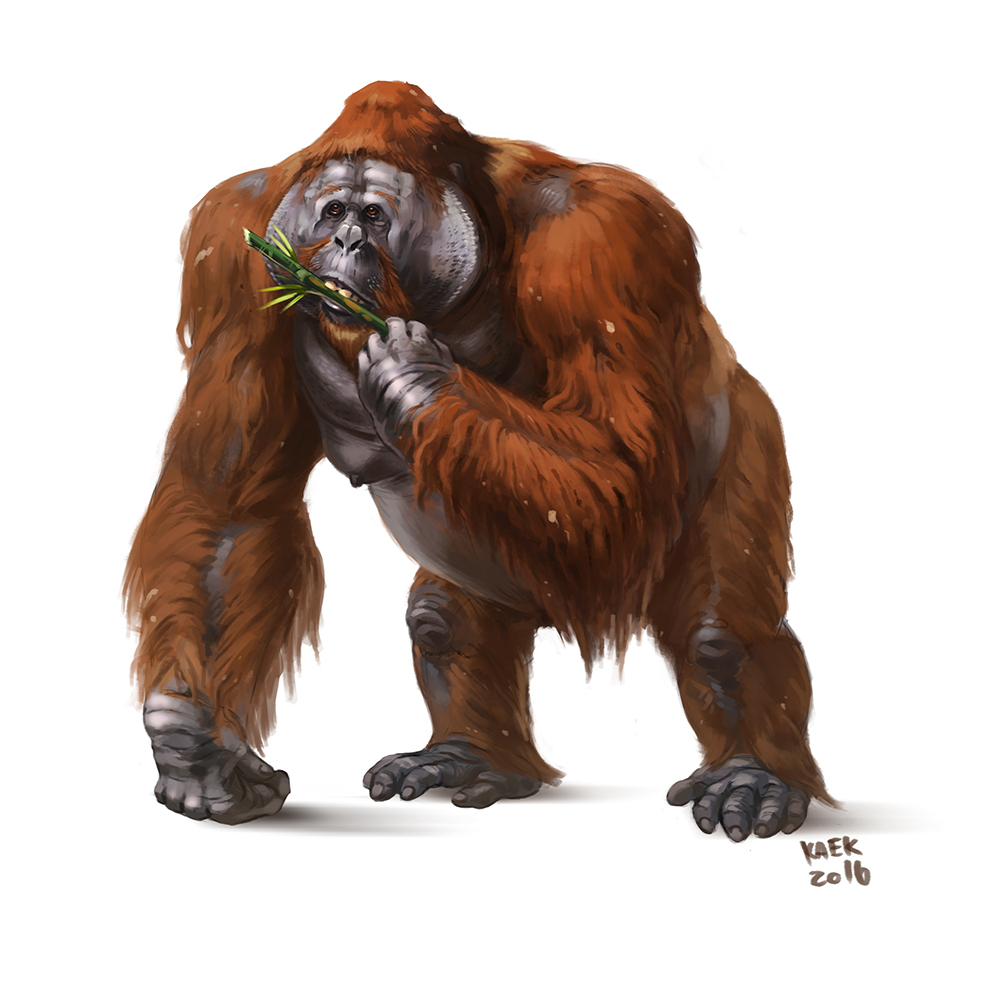 |
| Gigantopithecus blacki, by KaekArt, via Wikimedia |

Since I reworked chimpanzees, orangutans, and gorillas, I had to rework the dire ape as well. As previously statted up, the dire ape was a CR 3 monster with 19 Strength. That would make them less powerful than my gorillas. Heck, it puts this giant ape roughly on par with a walrus. So the new dire ape is a CR 6 monster with 23 Strength. It has two slams, a bite attack, and rend. In combat, the gigantopithecus will bring its incredible strength to bear on any attackers, rending them limb from limb.
The following text in gold is available as Open Game Content under the OGL. Open Game Content is ©2018 Jonah Bomgaars.
Monday, March 12, 2018
Return to the Plane of the Apes: Gorilla & Silverback
Today's Monster Monday is part II of our month-long series about apes. This week, we're presenting the gorilla and the silverback. Gorillas are the largest of the apes, though our imaginations often inflate their size. Although gorillas are gentle, intelligent, social animals, they are also territorial. When angered or threatened, they can put their incredible strength to good use, slamming their rivals with their massive arms gouging enemies with their strong, sharp teeth.
Each troop of gorillas is led by a dominant male called a silverback, who is always the largest and strongest of the troop. Most of the time, the silverback is the only male in the troop, though sometimes he has a cadre of adult male warriors at his command, called blackbacks. Because the silverback is so important to gorilla society, and because they are physically more powerful and more dangerous than other gorillas, I thought they deserved their own stat block.
You may know that the scientific name for the western gorilla is Gorilla gorilla, but do you know where the word gorilla comes from? It is a Greek translation of a Carthaginian Phoenician interpretation of an unknown West African word that may not have even referred to gorillas. According to Herodotus, around 500 BC the Carthaginian explorer Hanno the Navigator sailed down the coast of West Africa, encountering tribes of people, exploring strange islands and lakes, and founding settlements. After passing by a country devastated by forest fires or a volcano, he encountered gorillas:
From our first recorded encounter with gorillas (though Hanno's was obviously far from the first encounter), our two species have had a troubled co-existance. Today we recognize the importance of protecting these gentle giants, but past humans - especially past Europeans - haven't been so charitable. In that light, gorillas can certainly serve as a formidable foe in any campaign where they are encountered.
I should point out that both gorillas and chimpanzees are quadrupedal, rising to their hind legs only rarely. Chimpanzees can move a bit on their hind legs, but gorillas can only rear up. As such, I have given these apes the +4 to CMD vs trip attempts that quadrupedal creatures are entitled to, and that they were not given when they were originally statted up for Pathfinder.
The following text in gold is available as Open Game Content under the OGL. Open Game Content is ©2018 Jonah Bomgaars.
Each troop of gorillas is led by a dominant male called a silverback, who is always the largest and strongest of the troop. Most of the time, the silverback is the only male in the troop, though sometimes he has a cadre of adult male warriors at his command, called blackbacks. Because the silverback is so important to gorilla society, and because they are physically more powerful and more dangerous than other gorillas, I thought they deserved their own stat block.
 |
| Silverback gorilla. Photo by Pierre Fidenci, via Wikimedia |

On the third day after our departure thence, having sailed by those streams of fire, we arrived at a bay called the Southern Horn; at the bottom of which lay an island like the former, having a lake, and in this lake another island, full of savage people, the greater part of whom were women, whose bodies were hairy, and whom our interpreters called Gorillae. Though we pursued the men we could not seize any of them; but all fled from us, escaping over the precipices, and defending themselves with stones. Three women were however taken; but they attacked their conductors with their teeth and hands, and could not be prevailed upon to accompany us. Having killed them, we flayed them, and brought their skins with us to Carthage.It is open to debate whether the apes Hanno and his men encountered were gorillas or chimpanzees, or if this incident even occurred, but that is ultimately where we get the name 'gorilla'.
From our first recorded encounter with gorillas (though Hanno's was obviously far from the first encounter), our two species have had a troubled co-existance. Today we recognize the importance of protecting these gentle giants, but past humans - especially past Europeans - haven't been so charitable. In that light, gorillas can certainly serve as a formidable foe in any campaign where they are encountered.
 |
via Bayerische Staatsbibliothek and Wikimedia
Pictured: Almost certainly not how this encounter happened
|

The following text in gold is available as Open Game Content under the OGL. Open Game Content is ©2018 Jonah Bomgaars.
Monday, February 26, 2018
Monster Monday: Feral Hivemind, Abomination of the Gutter
Today's Monster Monday is the feral hivemind, an insidious urban aberration that uses psychic parasites to turn a city's population of feral animals into an army of mindless thralls. The feral hivemind appears to be made out of scraps of the animals that is dominates, connected by lumps of pulsing brain matter and strange alien flesh. Because few city dwellers take note of the wild animals living in their midst, a feral hivemind infestation often goes unnoticed until it is too late.
The following text in gold is available as Open Game Content under the OGL. Open Game Content is ©2018 Jonah Bomgaars.
 |
Monday, February 19, 2018
Monster Monday: Skimmers (Part 2) - Flying Jellyfish
Today's Monster Monday is part two of our exclusive exposé of flying electric jellyfish and how cool they are. Last week we talked about the man-sized skimmer and the smaller, bloodsucking crimson skimmer. This week we're going bigger:
The birdcatcher skimmer is almost transparent, floating through the sky on ocean-bourne winds and snaring seabirds in its shocking tentacles. The cloud jelly is the largest of the skimmers, looking somewhat like a small cloud trailing rain. It may not be a storm cloud, but its tentacles pack an electric punch.
The following text in gold is available as Open Game Content under the OGL. Open Game Content is ©2018 Jonah Bomgaars.
 |
| Cloud jelly and birdcatcher skimmer |
The following text in gold is available as Open Game Content under the OGL. Open Game Content is ©2018 Jonah Bomgaars.
Monday, January 29, 2018
Monster Monday: Shadow Cat, Predator in the Darkness
Today's Monster Monday is the shadow cat, a magical black panther infused with shadow magic, allowing it to blend into areas of darkness, teleport between shady spots, and even generate its own supernatural darkness. This predatory cat, from whose sleek black fur constantly seeps wisps of smokey darkness, is a formidable hunter in warm forested regions with lots of undergrowth.
(This is not to be confused with the Marvel superheroes Shadow Cat and Black Panther, which coincidentally are also the names of my laptop and my gaming PC.)
Encounters with shadowcats should be dynamic, with lots of movement as the creature strikes and repositions, taking full advantage of the environment to maneuver itself to strike at the party's weakest and least defended members.
The following text in gold is available as Open Game Content under the OGL. Open Game Content is ©2018 Jonah Bomgaars.
 |
| Panther illustration from Brehm's Life of Animals (1895), via the Biodiversity Heritage Library and Wikimedia |
_(6220155115).jpg)
Encounters with shadowcats should be dynamic, with lots of movement as the creature strikes and repositions, taking full advantage of the environment to maneuver itself to strike at the party's weakest and least defended members.
The following text in gold is available as Open Game Content under the OGL. Open Game Content is ©2018 Jonah Bomgaars.
Monday, January 15, 2018
Monster Monday: Brongya - Evil Yak Men of the Mountains
Today's Monster Monday is the brongya, a humanoid yak that binds elementals to its will and can possess the bodies of humanoids. Brongyai (the plural of brongya) live in hidden cities secreted away in high mountain valleys, where they rule over enslaved giants, bound genies, and servile elementals. Using magic and their ability to possess others, they lure unwary travelers into a false sense of security before capturing them for their own nefarious purposes. The brongyai believe themselves to be the predestined rulers of the world, and they delight in inflicting suffering and torment on those they see as 'slave races'. From their mountain strongholds, they secretly infiltrate and manipulate surrounding lands in centuries-long plots for conquest and domination.
The brongya is obviously heavily inspired by the yak folk first introduced to D&D in the al-Qadim campaign setting. Yak folk made their way into D&D 3rd Edition's Monster Manual II, which was released shortly before the switch over to 3.5 Edition. When Wizard's of the Coast created the Open Game License, upon which all of Pathfinder was built, that oddball 3rd Edition Monster Manual II sadly did not make it into the OGL, so the yak folk presented therein are still 'private property', as it were.
Even though a race of humanoid yaks seems pretty silly, they quickly became one of my favorite villains, and two of my longest running campaigns featured significant yak folk encounters. The brongyai are my OGL-friendly take on these not-so-classic, mostly-forgotten monsters, made from scratch without direct reference to the stat block in MMII. It is presented here so that all might someday live in fear of these surprisingly sinister shaggy bovine beasties.
The name brongya comes from the tibetan 'brong (འབྲོང), meaning 'wild yak'. Its alternate name, qutazi, comes from the tatar word for yak - qutaz (кутаз). The sword the brongya is holding in the picture is a forward-curving Nepalese sword called a kora - actually, a ceremonial executioner's version of the traditional kora.
The following text in gold is available as Open Game Content under the OGL. Open Game Content is ©2018 Jonah Bomgaars.
 |
| Brongya, by Jonah Bomgaars |
Even though a race of humanoid yaks seems pretty silly, they quickly became one of my favorite villains, and two of my longest running campaigns featured significant yak folk encounters. The brongyai are my OGL-friendly take on these not-so-classic, mostly-forgotten monsters, made from scratch without direct reference to the stat block in MMII. It is presented here so that all might someday live in fear of these surprisingly sinister shaggy bovine beasties.
The name brongya comes from the tibetan 'brong (འབྲོང), meaning 'wild yak'. Its alternate name, qutazi, comes from the tatar word for yak - qutaz (кутаз). The sword the brongya is holding in the picture is a forward-curving Nepalese sword called a kora - actually, a ceremonial executioner's version of the traditional kora.
The following text in gold is available as Open Game Content under the OGL. Open Game Content is ©2018 Jonah Bomgaars.
Monday, January 1, 2018
Monster Monday: Sivatherium - Dire Giraffe?
Today's Monster Monday is sivatherium, a prehistoric giraffe that had a moose-like head of antlers. Sivatherium was not as long-necked and spindly as modern giraffes. While its neck was rather long, this beast was thicker and stockier, weighing more than the average adult giraffe at around half the height. I guess you could think of it as a condensed giraffe. With antlers.
The sivatherium ranged across Africa and India during the Pliocene epoch and survived in some areas up until 8,000 years ago. It also had a really cool looking skull:
 |
photo by Hiuppo, via Wikimedia
Sivatherium reconstruction in the Museum of Evolution of Polish Academy of Sciences |

 |
photo by Ghedoghedo, via Wikimedia
Skull and leg of sivatherium giganteum in the Natural History Museum, London |

In a campaign setting, a sivatherium would stand out as an attractive target for a hunt, as it is tall and distinct enough to spot from far away, it is packed with almost a ton of meat, and its skull and hide would make distinctive trophies. It would also be challenging to hunt, as its high vantage point would give it advance warning of approaching enemies, and its long legs and neck would allow it to lash out at attackers with surprising reach.
The following text in gold is available as Open Game Content under the OGL. Open Game Content is ©2018 Jonah Bomgaars.
The following text in gold is available as Open Game Content under the OGL. Open Game Content is ©2018 Jonah Bomgaars.
Monday, December 18, 2017
Monster Monday: Aker, Two-Headed Golden Lion
On bare feet, the thief padded across the cold marble floors of the palace. Bars of moonlight filtered through shuttered windows as he slipped from shadow to shadow, keeping an ear open for guards. He saw them before he heard them - so still were they standing that even bedecked in gleaming mail they made little sound. Two palace guards, fauchards in hand, standing guard over an iron-bound door. This must be the hiding place of the Khwarzid Ruby.
The thief produced a small linen-wrapped tube from a pouch at his side. He slunk as close as he dared to the guards, keeping to their periphery where their vision was obscured by their helmets. At last, he took a deep breath, unwrapped the tube, placed it to his lips, and blew. A cone fine powder billowed out like the breath of some foul beast, choking the air around the guards. Purple lotus powder - a paralytic. It had cost the thief dearly, but it would all be worth it if he could get out of this palace with the ruby.
Wrapping a fold of his cape over his mouth and nose, he sprang into the poisonous cloud, catching one of the paralyzed guards before he could fall and, with a crash of armor against the stone floor, wake the entire palace. He held the guard up by the throat, but as he moved to catch the other, he was met with a blade. The second guard had not yet succumbed to the poison! He caught the edge of the thin dagger against his leather bracer and, right arm still holding up the first guard, began to grapple with the second guard with his off-hand. The towering brute of a guardsman stabbed at the thief awkwardly, slashing his back thrice with his blade before the purple lotus poison finally took hold. The thief silently lowered the two men, conscious but immobilized, to the floor.
The guards, of course, did not carry a key to the door they were guarding, so the thief picked the lock himself. He ignored a false keyhole, uncovered the true lock, bypassed a few trapped tumblers, and finally worked the door open. The room beyond the reinforced door glittered. Torches burned in wall sconces, casting orange light upon piles of gold, silver, and gems, which sparkled enticingly. In the center of the room rose a copper statue of a cobra, an enormous ruby clenched in its fanged jaws. A trap, obviously, but the thief saw no way to retrieve the ruby without triggering it. He knew he could afford to carry little else out of this room except the ruby, lest he be encumbered by it as he escaped. Still, he stuffed a handful of gold into his pouch as he approached the ruby, never taking his eyes off the snake statue for fear of being surprised by some wizardly trick.
The hair on the nape of his neck stood on end, his primal senses picking up on some danger his eyes had failed to notice. A low, purring growl began behind him, joined soon by a second. Whirling, he saw padding towards him a twin-headed lioness, fearsome in her power and beauty. Her fur gleamed just as brilliantly as the piles of gold she navigated between, as if the beast were herself wrought from the stuff. The thief froze, calculating his next move as the two-headed creature tensed and readied to pounce. Just as it move to strike, he whirled, snatched the ruby out of the snake's jaws, and ducked. Just as he expected, a spray of poison burst forth from some mechanism hidden in the snake's mouth. He could feel his back blistering where droplets of the poison splattered it. The beast growled and shook its heads, but was otherwise unfazed.
Immune to poison? Of course! This was an aker. The thief had heard tales of them in the south. Terrible golden lions with two heads. Legend held that ancient kings once used them to keep the giant snakes of those lands in check, for they were unaffected by the serpents' bites. The thief cursed as he ducked a swipe of the beast's claw. rolled to a pile of ceremonial weapons, and pulled a jeweled scimitar from its gilded sheath. He held it up prophylactically as the creature bit at him. One head caught the blade and bit clean through it. The other sunk its teeth into the thief's shoulder. Hot blood spilled out over the gold-strewn floor as the thief stifled a roar. He brought the shattered blade up and stabbed it deep into one of the beast's necks. It roared like a peal of thunder, surely waking the entire palace. Working quickly, he stabbed its neck over and over again until its eyes faded and closed. The other head snatched his sword-arm in its mouth and bit hard. The thief screamed, wrenching his arm from its mouth. He could not move his fingers, nor feel the pain he knew was there in his arm.
He cradled the ruby with his good hand, the other arm hanging dead at his side, and rolled between the legs of the aker. The beast wheeled to pursue, zigzagging awkwardly as its injured head hung limp from its bleeding neck. The thief knocked over a table covered with statuettes, but the aker crashed through it effortlessly. He leapt over a chest of coins and slid across the slick floor out through the open door. Guards were shuffling down the hall from both sides, leveling their polearms at the thief. The wounded aker burst through the door behind him, starling the guards for a moment. Just the moment the thief needed to act. Let them deal with each other, he thought. He sprung through the shuttered window and exploded out into the night air, plummeting toward the palace moat far below.
Today's Monster Monday is the aker, a two-headed lion often used as a guardian beast by the wealthy and the power-hungry. With golden fur and dual slavering maws, these creatures certainly make a statement when lounging at the foot of a petty warlord's throne or chained in the gardens of an extravagant maharaja.
The inspiration for this monster came from a picture in the 2nd edition AD&D al-Qadim supplement showing a rogue sneaking into the gold-strewn chamber of a sleeping giant and confronted by a roaring two-headed lion (page 45 for those of you following along at home). As I began to stat the creature up, I realized I needed a name for it, so I searched for a mythological precedent for a two-headed lion. What I found was Aker, an Ancient Egyptian deity often depicted as two lions or a two-headed lion who protects the pharaoh from poisonous snakes. This lent some additional character to my monster, and its protective nature fit in well with the picture of it as a treasure guardian.
The following text in gold is available as Open Game Content under the OGL. Open Game Content is ©2017 Jonah Bomgaars.
Monday, November 13, 2017
Monster Monday: Seafoam Slime, the Coastal Creeper
Today's Monster Monday is seafoam slime, an aquatic ooze that lurks in the shallows waiting to rush out like a rogue wave and tackle its prey, pinning them and filling their lungs with foamy water so that it can drag them back into the surf to feed.
 The seafoam slime has Improved Bull Rush, Trip, and Drag, allowing it to unleash a barrage of combat maneuvers designed to disrupt a small part of adventurers in a way that feels very natural for what basically amounts to a living wave. It may be a CR 4 monster, but its Drown ability means it can easily incapacitate an unwary adventurer if it gets the drop on them.
The following text in gold is available as Open Game Content under the OGL. Open Game Content is ©2017 Jonah Bomgaars.

 |
photo by Brocken Inaglory, via Wikimedia
Sea foam at Ocean Beach, San Francisco |

Monday, November 6, 2017
Monster Monday: Amphicyon, Prehistoric Bear-Dog
Today's Monster Monday is amphicyon, also known as the bear-dog, a prehistoric predator related to both bears and dogs, which had features of each. The largest bear dog species had the size and power of grizzly bears, while smaller bear-dogs acted more like wolves. The bear dog statted up below is somewhere in between - a predator with the bulk and strength of a black bear, but a more wolf-like head and tail.
Amphicyonids in all their myriad forms roamed across North America, Europe, Asia, and Africa from 46 to 1.8 million years ago. The larger, more bear-like species were probably omnivorous, but ate more meat than modern brown and black bears. The smaller amphicyonid species could be represented by the stat blocks for wolf, dog, or dire racoon, or by applying the young simple template to the stat block below. Giant amphicyonids like amphicyon ingens can be made by applying the giant simple template.
Also, I bet their cub-puppies were adorable.
The following text in gold is available as Open Game Content under the OGL. Open Game Content is ©2017 Jonah Bomgaars.
 |
| Reconstruction of the amphicyonid Ysengrinia from an article by Borja Figueirido, Juan A. Pérez-Claros, Robert M. Hunt, Jr., and Paul Palmqvist, drawing by Óscar San−Isidro, via Wikimedia |

Also, I bet their cub-puppies were adorable.
The following text in gold is available as Open Game Content under the OGL. Open Game Content is ©2017 Jonah Bomgaars.
Tuesday, October 31, 2017
Seven Spooky Skeletons - Ubbe the Spooky
Seven Spooky Skeletons is a short series running until Halloween, showcasing a different unique skeletal villain each night.
Tonight's Spooky Skeleton is Ubbe the Spooky, a cavorting skeleton bard who plays his own ribcage as a xylophone. Ubbe is named after legendary animator and Mickey Mouse co-creator Ubbe 'Ub' Iwerks, who animated the classic Silly Symphony, "The Skeleton Dance," which is mandatory Halloween viewing.
Happy Halloween!
The following text is available as Open Game Content under the OGL. Open Game Content is ©2017 Jonah Bomgaars.
Tonight's Spooky Skeleton is Ubbe the Spooky, a cavorting skeleton bard who plays his own ribcage as a xylophone. Ubbe is named after legendary animator and Mickey Mouse co-creator Ubbe 'Ub' Iwerks, who animated the classic Silly Symphony, "The Skeleton Dance," which is mandatory Halloween viewing.
Happy Halloween!
The following text is available as Open Game Content under the OGL. Open Game Content is ©2017 Jonah Bomgaars.
This bare skeleton dances rhythmically as it
plays out a chilling xylophone solo on its own ribcage
Ubbe the Spooky CR 6
XP 2,400
Human
skeletal champion bard 8
NE Medium undead
Init +8; Senses darkvision 60 ft.; Perception +14
DEFENSE
AC 19, touch 17, flat-footed 12 (+4
Dex, +2 natural, +3 dodge)
hp 95 (10d8+50)
Fort +14, Ref +10, Will +10; +4
channel resistance, +4 vs bardic performance, language dependent, sonic
DR 5/bludgeoning; Immune cold, undead traits
OFFENSE
Speed 35 ft.
Melee percussive bone club +6/+6/+1/+1
(1d6+1 plus 1d4 sonic)
Ranged returning percussive bone club +11
(1d6+1 plus 1d4 sonic) 10ft.
Special Attacks bardic performance 29
rounds/day (countersong, dirge of doom, distraction, fascinate, inspire
competence +3, inspire courage +2, suggestion,
unhallow)
Spells Known (CL 8th)
3 3rd (3/day; DC 18) – blink, fear, thundering drums
4 2nd (5/day; DC 17) – allegro, distressing tone, haunting mists, mad
hallucination
5 1st (6/day; DC 16) – cause fear, ear-piercing scream, expeditious
retreat, hideous laughter, vanish
6 cantrips (at will; DC 15) – daze, ghost sound, mage hand, open-close, prestidigitation,
summon instrument
STATISTICS
Str 12, Dex 18, Con --, Int 12, Wis 13, Cha 20
Base Atk +7; CMB +8; CMD 22
Feats Dodge, Double Slice, Extra
Performance, Fleet, Improved InitiativeB, Improved Two-Weapon
Fighting, Two-Weapon Fighting
Skills Acrobatics +17, Bluff +18, Diplomacy
+13, Escape Artist +9, Intimidate +18, Knowledge (local) +9, Knowledge
(religion) +9, Perception +14, Perform (dance) +18, Perform (percussion) +18, Sense
Motive +9, Spellcraft +5, Stealth +12, Use Magic Device +9
Languages Common, Necril
SQ bardic knowledge +4, lore master, versatile
performance (dance, percussion)
SPECIAL ABILITIES
Loose Joints (Ex)
Ubbe the
Spooky can separate the joints of his bones at will and come back together a
moment later, allowing him to, for example, dodge a sword blow to the neck by
throwing his skull up into the air. This grants Ubbe a +2 dodge bonus to his
AC.
Play Dead (Ex)
Ubbe the
Spooky can collapse into a pile of disconnected bones as an immediate action,
granting him a +10 bonus to his Bluff check to pretend to be destroyed. This
bonus applies only for the first time he uses it against any given observer.
Ubbe can reassemble himself as a move action that provokes attacks of
opportunity.
Percussive Bones (Su)
Ubbe can use
his own bones and the bones of other skeletons as percussion instruments. Any
bone he wields as a weapon counts as a club and deals an additional 1d4 points
of sonic damage. Any bones he throws as a weapon gain the returning weapon quality.
Unhallow (Su)
Ubbe the
Spooky has access to a special bardic performance called unhallow. While ubbe
makes an unhallow performance, all undead creatures within 50 feet gain 5 bonus
hit points and channel resistance +2. This channel resistance stacks with any
existing channel resistance.
ECOLOGY
Treasure none
Ubbe the
Spooky is a cavorting skeleton bard. In life, he was a morose and ill-tempered performer
who, while talented and beloved by his fans, despised himself and his work. It
is said that, while in one of his fits of depression, he heard a joke that
caused him to break out into such raucous laughter that he died instantly. In
death, he found new purpose in his performances which had eluded him in life. He
has devoted his unlife both to poking fun at death and to reminding mortals of
their inevitable demise through song and dance. He takes special delight in
scaring people to death. He sees life as an elaborate practical joke to which
death is the punchline.
~~~~~~~~~~~~~~~~~~~~~~~~~~~~
-your seventh spooky d20 despot
Seven Spooky Skeletons - The Hanged Archer
Seven Spooky Skeletons is a short series running until Halloween, showcasing a different unique skeletal villain each night.
Tonight's Spooky Skeleton is the Hanged Archer, a blind skeleton with a noose around its neck and a sack over its head who is a supernaturally excellent marksman. Once a poacher of the king's game, now he poaches man.
The following text is available as Open Game Content under the OGL. Open Game Content is ©2017 Jonah Bomgaars.
Tonight's Spooky Skeleton is the Hanged Archer, a blind skeleton with a noose around its neck and a sack over its head who is a supernaturally excellent marksman. Once a poacher of the king's game, now he poaches man.
The following text is available as Open Game Content under the OGL. Open Game Content is ©2017 Jonah Bomgaars.
This skeleton wears an old noose around its
bony neck and a sack of burlap over its head. Despite its obscured vision, it
bears a longbow, to which it nocks an arrow with practiced ease.
The Hanged Archer CR 5
XP 1,600
Human
skeletal champion ranger 7
CE Medium undead
Init +9; Senses blindsight 500 ft.; Perception +4
DEFENSE
AC 18, touch 16, flat-footed 12 (+5
Dex, +1 dodge, +2 natural)
hp 72 (2d8+7d10+25)
Fort +8, Ref +11, Will +7; +4
channel resistance
DR 5/bludgeoning; Immune cold, undead traits
Defensive Abilities vulnerability
OFFENSE
Speed 30 ft.
Melee mwk morningstar +12/+7 (1d8+3)
Ranged +1 composite longbow +15/+10 (1d8+4/x3) 100ft.
Special Attacks favored enemy (humans
+4, animals +2)
Spell-Like Abilities (CL 9th)
1/day – quickened true strike
Spells Prepared (CL 4th)
1 2nd – acute senses
2 1st – gravity bow, jump
STATISTICS
Str 16, Dex 20, Con --, Int 10, Wis 15, Cha 14
Base Atk +8; CMB +11; CMD 26
Feats Deadly Aim, Dodge, Far Shot, Improved
InitiativeB, Point-Blank ShotB, Precise Shot, Rapid ShotB,
Vital Strike, Weapon Focus (longbow)
Skills Climb +11, Craft (traps) +10, Intimidate
+10, Knowledge (nature) +12, Perception +14, Sense Motive +11, Stealth +17,
Survival +14
Languages Common
SQ favored terrain (forest +2), hunters
bond (companions), track (+3 to follow tracks), wild empathy, woodland stride
SPECIAL ABILITIES
Blind Archer (Su)
The Hanged
Archer is blind, but has access to supernatural senses that give him perfect blindsense
out to 500 feet. From 500 to 1000 feet, his blindsense grows hazy (targets gain
20% concealment), and beyond 1000 feet he can see nothing. His supernatural
senses also give him quickened true
strike as a spell-like ability once per day.
Blinding Critical (Ex)
Whenever the
Hanged Archer scores a critical hit against a favored enemy, in addition to the
damage dealt by the crit, the target permanently blinded in one eye.
ECOLOGY
Treasure NPC gear (mwk morningstar, +1 composite longbow (+3 Str), 18
arrows, 2x +1 dwarf bane arrows, 2x +1 elf bane arrows, 2x +1 gnome bane arrows, 2x +1 halfling bane arrows, 2x +1 human bane arrows, 2x +1 orc bane arrows, masterwork quiver,
other treasure)
The Hanged
Archer bears the noose that he was hanged with around his neck, and the burlap
sack from the hanging still covers his head. His bones are yellowed with age
and smudged with dirt. In life, he was a poacher and an expert marksman. He
delighted in demonstrating his prowess with the bow at every opportunity, and
often embarrassed the king’s gamekeepers who pursued him. When he was finally
captured, his eyes were gouged out before he was publicly hanged. In undeath,
he has begun hunting man, and he has found that he is even better at it than he
ever was at poaching deer.
~~~~~~~~~~~~~~~~~~~~~~~~~~~~~
-your sixth spooky d20 despot
Thursday, October 26, 2017
Seven Spooky Skeletons: Woodbones
Seven Spooky Skeletons is a short series running every night until Halloween, because I love Halloween, alliteration, and the word 'spooky'. Each night, d20 despot will be showcasing a different unique skeletal villain.
Tonight's spooky skeleton is Woodbones, an undead, bark-encrusted druid who summons skeletal animals and rides a bony bear infused with the spirit of an evil tree.
The following text is available as Open Game Content under the OGL. Open Game Content is ©2017 Jonah Bomgaars.
Tonight's spooky skeleton is Woodbones, an undead, bark-encrusted druid who summons skeletal animals and rides a bony bear infused with the spirit of an evil tree.
The following text is available as Open Game Content under the OGL. Open Game Content is ©2017 Jonah Bomgaars.
This halfling skeleton is partially fused
with plates of ragged bark. It sits astride a skeletal bear bristling with
woody vines.
Woodbones CR 6
XP 2,400
Halfling
skeletal champion druid 8
NE Small undead
Init +7; Senses darkvision 60 ft., greensight; Perception +13
DEFENSE
AC 20, touch 15, flat-footed 16 (+1
size, +3 Dex, +5 natural, +1 dodge)
hp 73 (10d8+28)
Fort +9, Ref +7, Will +14; +4
channel resistance, +4 vs. effects from fey and effects using plants
DR 5/bludgeoning; Immune cold, undead traits
Defensive Abilities resist nature’s
lure
OFFENSE
Speed 20 ft.
Melee +1 quarterstaff +8/+8/+3 (1d4+2) or 2 claws +9 (1d3+1)
Ranged +1 sling +11 (1d3+2) 50ft.
Spell-Like Abilities (CL 8th;
concentration +12)
constant – greensight
1/day – tree
shape
Spells Prepared (CL 0th)
4th
– bloody claws, inflict serious wounds (DC
18), thorn body
3rd
– call lightning (DC 17), fungal infestation (DC 17), greater magic fang, inflict moderate wounds (DC 17)
2nd
– barkskin, fog cloud, frigid touch, wood shape
1st
– bristle, decompose corpse, liberating command, magic stone, shillelagh
orisons – create water, detect magic, light,
resistance
STATISTICS
Str 12, Dex 16, Con --, Int 11, Wis 18, Cha 15
Base Atk +7; CMB +7; CMD 20
Feats Dodge, Improved InitiativeB,
Mounted Combat, Natural Spell, Two-Weapon Fighting
Skills Acrobatics +5, Climb +3, Intimidate
+7, Handle Animal +9, Heal +8, Knowledge (nature) +10, Perception +13, Ride +16,
Stealth +16, Survival +11; Racial
Modifiers +2 Acrobatics, +2 Climb, +2 Perception
Languages Common, Halfling, Druidic
SQ nature bond (skeletal animal
companion), nature sense, skeletal wild shape, spontaneous casting, trackless
step, undead wild empathy, woodland stride
SPECIAL ABILITIES
Bark Armor (Ex)
Woodbones’
bones are fused with the bark of the Tree of Death, granting him a +4 natural
armor bonus on top of the existing natural armor bonus granted by the skeleton
template.
Blessing of the Tree of Death (Ex)
The Tree of
Death gave Woodbones many gifts. Woodbones gains greensight as a constant spell-like ability and tree shape as a spell-like ability
useable once per day. It also adds any inflict
wounds spells to its druid spell list.
Skeletal Animal Companion (Ex)
Woodbones’
animal companion gains the skeletal champion template. The companion retains
all special qualities granted to an animal companion. In addition, planted
within the heart of the skeletal animal is a sapling descended from the Tree of
Death. This grants the skeletal animal companion a +4 bonus to grapple checks,
a +4 bonus to Charisma, and the ability to cast entangle as a spell-like ability once per day with a caster level
equal to Woodbones’.
Root, The Skeletal Bear
Bear skeleton animal companion
N Medium undead
Init +6; Senses low-light vision, darkvision 60 ft., scent; Perception +0
DEFENSE
AC
20, touch 12, flat-footed 18 (+8 natural, +2 Dex)
hp
58 (9d8+18)
Fort
+6, Ref +6, Will +5; +4 channel resistance, +4 vs enchantments
DR
0/-; Immune immunity, undead traits
Defensive
Abilities devotion, evasion
OFFENSE
Speed
40 ft.
Melee
bite +11 (1d6+5), 2 claws +11 (1d4+5)
Spell-Like
Abilities (CL 8th)
1/day – entangle
STATISTICS
Str
21, Dex 15, Con --, Int --, Wis 10, Cha 14
Base
Atk +6; CMB +11; CMD 23
Feats
Improved InitiativeB
SQ
link, share spells
Skeletal Wild Shape (Su)
Woodbones can
assume the form of any skeletal animal of Tiny, Small, Medium, or Large size.
This ability functions like the spell undead
anatomy II except as noted here. The effect lasts for eight hours or until
it changes back. Changing form is a standard action and doesn’t provoke attacks
of opportunity. Woodbones’ skeletal animal forms retain its bark armor and +4
natural armor bonus. Woodbones can use this ability three times to day.
Skeletal Summons (Su)
Any
creatures summoned when Woodbones casts summon nature’s ally or similar
summoning spells are summoned with the skeleton or exoskeleton template, as
appropriate. Summoned elementals are not affected by this change.
Undead Wild Empathy (Ex)
Woodbones
can improve the attitude of an undead animal just as a living druid can with a
living animal. Woodbones can use this ability to influence an undead magical
beast with an Intelligence score or 2 or lower.
ECOLOGY
Treasure NPC gear (+1 quarterstaff, +1 sling,
40 bullets, potion of inflict serious wounds (CL 5th), other
treasure)
This
halfling skeleton’s bones are partially fused to tough sheets of thick bark,
forming a crude sort of armor. Some of its bones are missing, replaced with
perfectly crafted wooden doubles. In life, this creature was a halfling druid.
It died at the foot of the legendary Tree of Death, the bark of which grew over
its corpse, decomposed it, and infused it with dark powers. All other aspects
of its past identity have been stripped away by the ages, leaving only the husk
known as Woodbones, Servant of the Tree of Death. It rides a skeletal bear named
Root, which bears the thrashing, evil sapling of the Tree of Death in its
rib-cage. Together, they seek to bring a twisted balance to nature by hastening
the death and decay of all living things.
~~~~~~~~~~~~~~~~~~~~~~~~~~~~~~~~~~~~~
-your second spooky d20 despot
Subscribe to:
Posts (Atom)