Sunday, December 20, 2015

The Chaining of Krampus - TEASER

Cold winter winds whip through the candy cane forest.  The mighty red-and-white-striped trees creak and strain against the force.  The wind bites at your cheeks and nips at your nose, though it smells pleasantly of peppermint.  The only light is cast by a single lamp post around which you have all gathered, awaiting the arrival of your contact.  A sudden sound to your right startles you.  You look over, expecting the Big Man’s arrival, but it is only an arctic beaver, painfully overweight and probably diabetic, gnawing on a candycane stump. 

“Ho ho ho!” rumbles a deep voice behind you.  How did such a big man sneak up like that? You turn and see him, wrapped head to toe in a long red cloak trimmed with white fur.  His hood is pulled up, partially obscuring his face, though there is no mistaking that man for someone else.  That snow-white beard, that rotund belly, that rosy red nose.  He needs no introduction. 


"Santa is glad you all could make it!” he says.  “After the services you provided me last year, I knew I could count on you:

"Krampus has become a wild beast, and he needs to be chained."  

~~~~~~~~~~~~~~~~~~~~~~~~

Later this week, I will be posting The Chaining of Krampus, part two of the adventure begun last year in Escape from the Lair of the Krampus.  The free adventure is designed for 4-6 ninth-level characters.  Pre-generated characters will be included.

I got some good feedback on last year's adventure that I have taken into account.  I'm trying to make this one shorter so that it can fit into one session, but I make no promises.  Personally, I'll probably be running this adventure with a group of six players after Christmas dinner, and hopefully again with a different group before the New Year.  If you are looking for a light-hearted holiday-themed adventure to run for your gaming group this Christmas season, keep an eye out later this week for The Chaining of Krampus!

-your jolly d20 despot

Monday, December 14, 2015

Monster Monday: Ice Cube - The Freezing Ooze

Today's Monster Monday is an ice cube, an arctic version of the gelatinous cube that will literally chill you to the bone and leave behind nothing more than an eerily lifelike ice sculpture.

Photo by Editor at Large, via Wikimedia
Ice cubes will be making an appearance in this winter's holiday adventure, The Chaining of Krampus, a continuation of last year's Escape from the Lair of the Krampus.  I'll be trying to get that adventure finished as soon as possible - hopefully earlier than last year's embarrassing release date of December 26th.  I'll also try to make it shorter than last year's installment, which tended to take two sessions to finish.  Stay tuned to d20 Despot for more news on this free Christmas-themed adventure!

The following text in gold is available as Open Game Content under the OGL. Open Game Content is ©2015 Jonah Bomgaars.

Monday, December 7, 2015

Monster Monday: Snegurochka - Slavic Snow Maiden

Today's Monster Monday is Snegurochka, the snow maiden of 19th century Slavic mythology.  In the tales, snegurochka is a being of pure snow whose curiosity about humans leads her to tragically melt (either from jumping over a fire as part of a game, or from falling in love).  Later, she becomes the helper and granddaughter of Ded Moroz, the Russian Santa.

I have statted her up as a supernatural being with powerful snow magic, capable of turning into a flurry of snowflakes or passing on winter's chill with her touch.  Her natural curiosity attracts her to human settlements, but a bad run-in with fire or warmth can lead her to violent outbursts against those who inadvertently threaten her with melting.

Снегурочка by Boris Zvorykin, via Wikimedia
The following text in gold is available as Open Game Content under the OGL. Open Game Content is ©2015 Jonah Bomgaars.

Wednesday, December 2, 2015

Improved Armor Tables Part 6 - Partial and Piecemeal Armor


This is part 6 of my ongoing series on improving the armor tables.  Unlike my Fixing the Weapons Table posts, these changes should be considered entirely optional and a GM should carefully consider whether they want to use them in their game, because it might mean a lot of tweaking stat blocks behind the scenes.  These changes are designed for GMs who love history and want their fantasy worlds to be a little more grounded in it.

This week I'm dropping the rules for partial and piecemeal armor, followed by some examples that illustrate the versatility of this system.  Thus far, the armor I have presented has been full-body armor, protecting the wearer more-or-less head-to-toe.  The following rules will allow a character to lighten the load by wearing only torso armor, or mix-and-match different armors to customize their dungeon-delving ensemble.

Pathfinder already has some armors that I would consider 'partial armors' - the breastplate and chain shirt spring to mind - though their relationship to more complete armors is ill-defined.  There are also already rules for piecemeal armor, but I find them overly complicated and not particularly versatile.  By their system, piecemeal armor is divided into torso, arm, and leg armor, and the only way to determine the stats of any given piece of armor is to find it on their tables.  I have created a more versatile, consistent system of rules that lets you break down any suit of armor into two pieces (torso armor and limb protection), and mix and match them.  I developed it for my own improved armor tables, but these rules can also be easily applied to the base Pathfinder armors, armor created for the d20 system by a third party, or your own homebrewed armors.

The following items and rules in gold and their accompanying tables are available as Open Game Content under the OGL.  Open Game Content is ©2015 Jonah Bomgaars and d20 Despot.

Monday, November 23, 2015

Review: Pathfinder Bestiary 5


Bestiary 5 for the Pathfinder Roleplaying Game is out now!  But should you buy it?  As a general rule of thumb for Pathfinder Bestiaries or D&D Monster Manuals, the higher the number in the title, the less useful it is.  This is something I learned before I ever started playing D&D.  When I went over to my friend Marc's house in junior high school, I would flip through his monster manuals and marvel at the strange collection of beasts therein.  I soon realized that, while there were some pretty weird creatures throughout all the books, it was the higher-numbered ones that were more likely to contain cheesy, dumb, or downright bizarre monsters destined never to be included in a random monster table or emblazoned on some knight's shield.  It was Monster Manual IV, after all, that famously gave us the ice-skating dragon.

© WOTC
Not that there is anything inherently wrong with weird monsters; beholders and rust monsters are pretty darn weird, but they are also iconic, interesting, and truly threatening monsters that are easy for GMs and players alike to grasp.  A monster can get away with being weird if it has been around for a long time, or if its underlying concept is really engaging.  I knew Bestiary 5 was in trouble when I opened to a random page and saw this:

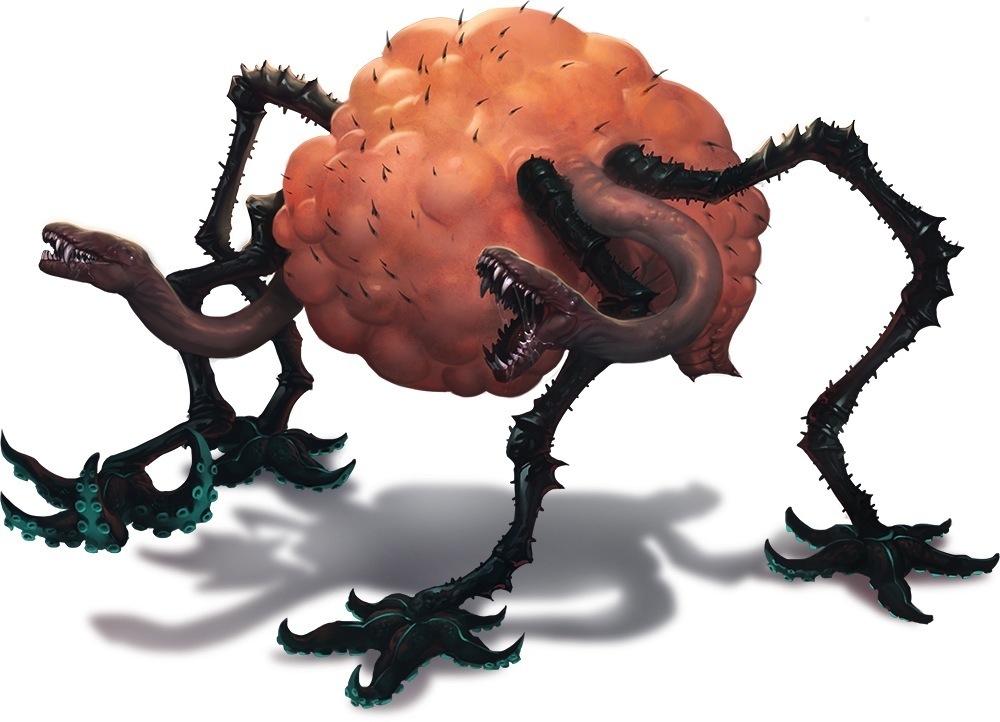
© Paizo
That's a dwiergeth, and its name is just as much of a random jumble of consonants and vowels as its body is a random jumble of monster parts.  But Bestiary 5 isn't all dwiergeths and aatheriexas, it is also packed with beasts from Greek, Egyptian, Mapuche, Inuit, and Slavic mythology (and many more), plus crazy sci-fi creatures and and odd occult horrors.  As I read on, I knew I had to create a metric that I could use to review each monster individually and compile them to get a sense of how useful the bestiary was overall.  The results are below.

Monday, November 16, 2015

Monster Monday: Ketos, Sea Monster of Divine Retribution

Today's Monster Monday is the ketos, an ancient sea monster from Greek and Biblical mythology.  This is the monster that Poseidon sent to eat Andromeda, and that Perseus petrified with Medusa’s severed head.  The ketos is also frequently shown as the sea monster that swallowed Jonah in late classical and medieval depictions of the story.  In both cases, it is a monster sent by a deity to punish the impious by eating someone.

Andromeda liberata da Perseo by Piero di Cosimo, via Wikimedia
Herakles, appropriating the myth of Perseus and Andromeda, apparently also rescued a princess from a ketos, doing so in true herculean fashion by leaping into its mouth and slaying it from within.  In 58 BC, the Romans put the bones of what they believed to be the ketos that Perseus slew on display during gladiatorial games.  The bones were described as “forty feet long, with ribs taller than an Indian elephant, and spines eighteen inches thick.” 

"Hercules Slays the Ketos" from vase painting in Athens, Stavros S Niarchos Collection.
Many medieval depictions of the inside of the whale emphasize its overwhelming heat, to the point where at least one such depiction has Jonah going bald from the heat.  In a late tenth century tale recounted by the French monk Letaldus, with parallels to the story of Jonah, a fisherman named Within is swallowed by a great whale and kills the whale by setting his boat on fire and attacking the creature’s insides with his sword.  After four days and five nights, he is washed up in the whale's carcass and emerges hairless.  The whale that swallows Within is likened to Scylla and Charybdis, and described “with snake-like teeth and with an ever gaping gullet, a gullet that could tumble entire cities to the underworld.”  

Photo by wmpearl, via Wikimedia
Jonah Cast Up, 280-290 CE, marble, late Roman, Asia Minor, Cleveland Museum of Art
The following text in gold is available as Open Game Content under the OGL. Open Game Content is ©2015 Jonah Bomgaars.

Monday, November 9, 2015

Improved Armor Tables Part 5 - Heavy Armor


This is part 5 of my ongoing series on improving the armor tables.  Unlike my Fixing the Weapons Table posts, these changes should be considered entirely optional and a GM should carefully consider whether they want to use them in their game, because it might mean a lot of tweaking stat blocks behind the scenes.  These changes are designed for GMs who love history and want their fantasy worlds to be a little more grounded in it.

This week's subject is heavy armor.  This is the armor for those who can afford it, for while it may be more restrictive and, well, heavier than other armors, the protection it provides is second to none.  In the category of heavy armor, we have banded armor, bronze plate, mail-and-plate, heavy mail, bronze panoply, plate, and full plate.  This is armor for your characters that can take a beating and give one back in return: your stalwart legionnaires, your axe-wielding sea-raiders, your shining knights errant, and your bloodthirsty horsemen of the steppe.

Fans of plate armor will be pleased to see that, in these tables, plate and full plate offer more flexibility than they do in Pathfinder or D&D 3.5.  This is some of the best armor ever made, worn by the wealthiest warriors of Europe.  They would not have fought in it if it restricted their movements and limited their ability to fight.  It may have been heavy, but the way it was made and worn distributed its weight across the whole body, making it feel lighter than mail.

Read on to see the stats for all these armor types and learn more about them.  As before, I have provided some historical information with each armor entry in order to aid the GM in determining which armors would fit best in a particular campaign setting.

The following items and rules in gold and their accompanying tables are available as Open Game Content under the OGL.  Open Game Content is ©2015 Jonah Bomgaars and d20 Despot.