Showing posts with label prehistoric monsters. Show all posts

Monday, August 6, 2018

Monster Monday: Ammonites - Spiral-Shelled Cephalopods of Prehistoric Seas

Today's Monster Monday is the ammonite, a hard-shelled nautilus-like creature that floated through the prehistoric seas for some 350 million years before being wiped out in the same extinction that ended the age of the dinosaurs.

Ammonites typically had a spiral shell made up of successively smaller chambers that they could flood with gas or water to control their buoyancy. The animal itself was a cephalopod, probably ten-armed, which protruded from the end of the shell. Some ammonites may have been able to withdraw into their shells like a modern nautilus or a snail. Some may have had ink they could release in a cloud like modern squid and octopuses. But when we are talking about ammonites, we are talking about thousands of species across hundreds of millions of years - there was room for plenty of variation. Some - like the nostoceratidae - had irregularly unwound shells and probably floated through the sea like plankton or jellyfish. Some just crawled along the sea floor. Most ammonites were small, with shell spirals reaching no larger than 9 inches in diameter. But the two types of ammonites we will be looking at today were big.

photo by Ghedoghedo, via Wikimedia
Titanites giganteus - Natural History Museum, London
Titanites giganteus did not let the ocean currents decide where it would go, as if it were some kind of overgrown plankton. No, titanites was a swift hunter, jetting through the ocean in search of prey it could wrap its probing tentacles around and gnaw with its sharp beak. Their shells reached 2-3 feet in diameter, much larger than the typical ammonite of its day. But even the bigly named titanites giganteus was dwarfed by:

photo via Wikimedia
German zoologist Hermann Landois sitting next to his fossil of Parapuzosia seppenradensis,
with a wire frame showing the projected size if the specimen were complete. 
Parapuzosia seppenradensis may be a mouthful of a name, but you would be hard pressed to find a predator capable of making this ammonite into a mouthful. The 5.9 foot diameter fossil seen above is broken - with its intact living chamber, estimates put this specimen at 8.4 to 11 feet in diameter, making it by far the largest ammonite species. In life, the creature may have weighed 3,200 pounds, fully half of which comes from its massive shell. If parapuzosia was a hunter like titanites was, it must have been an impressive and terrifying sight to behold.

The following text in gold is available as Open Game Content under the OGL. Open Game Content is ©2018 Jonah Bomgaars.

Tuesday, June 12, 2018

Monster Monday: Xiphactinus, Prehistoric Monster Fish

Today's Monster Monday is xiphactinus, a giant prehistoric monster fish known for swallowing other large fish whole. These ugly fish reached lengths of 15 to 20 feet and swam the seas of the Late Cretaceous, when Tyrannosaurus was roaming the land.

Xiphactinus audax life restoration by ДиБгд, via Wikimedia
It's no secret that I am a fan of prehistoric sea life. Xiphactinus may not be as well-known as, say, ichthyosaurus, but its fossils certainly leave an impression. Not only are they big and mean looking, with those upturned, toothy maws, but they often show another pretty big fish trapped within the fossil ribs of the xiphactinus. Of course it can swallow an adventurer whole. And we know they didn't just settle for prey "small" enough to swallow - a 20 ft. xiphactinus fossil found in Canada in 2010 had the flipper of a mosasaur in its jaws.

photo by Spacini, via Wikimedia
Xiphactinus audax with a delicious Gillicus arcuatus in its stomach.
Fossils on display at the Sternberg Museum of Natural History in Hays, Kansas
This also marks d20 Despot's first monster that starts with an 'X'. My patrons on Patreon know that it won't be the last: coming up fairly soon, we have another 'X' monster, this one from Aztec mythology.

The following text in gold is available as Open Game Content under the OGL. Open Game Content is ©2018 Jonah Bomgaars.

Monday, March 19, 2018

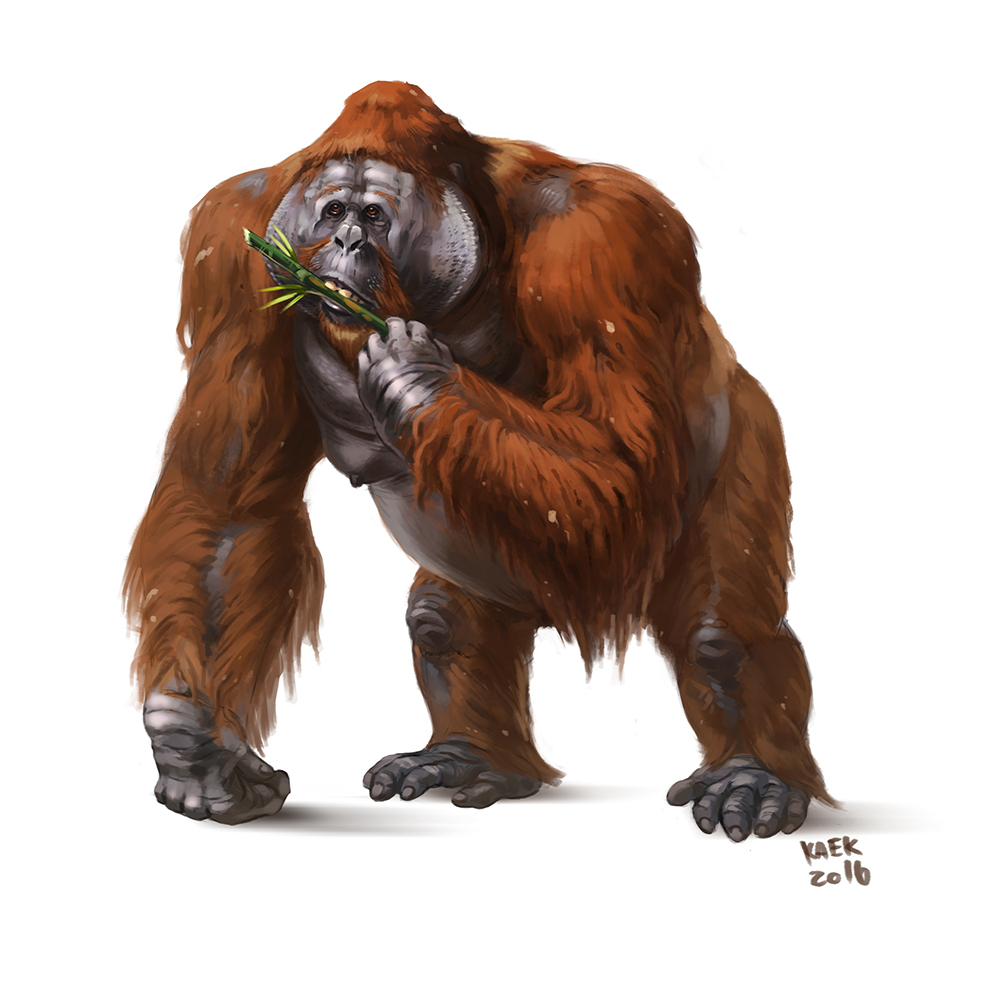
Dawn of the Plane of the Apes: Gigantopithecus, Dire Ape

Today's Monster Monday is part III of our month-long series about apes. This week, we're looking at the dire ape, or gigantopithecus. Gigantopithecus stood nearly 10 feet tall at full extension, making it a gigantic hulk of an ape. Older depictions of gigantopithecus often make it look like a giant gorilla, but the closest living relative of this giant Asian ape is actually the orangutan.

Gigantopithecus blacki, by KaekArt, via Wikimedia
We don't have a lot of fossils of gigantopithecus - mostly teeth from caves in China, India, and Vietnam. One thing missing are its pelvic bones, so we don't know for sure whether it walked upright like a human or on all fours like most apes. Given its bulk and the rarity of upright locomotion, it seems most likely that it used its arms and legs to walk, like a gorilla. But that hasn't stopped cryptozoologists from speculating (unfounded speculation is what they do, after all) that relic populations of gigantopithecus are responsible for sightings of sasquatches and yeti. That is, of course, dumb, but it is a gigantopithecus fun fact.

Since I reworked chimpanzees, orangutans, and gorillas, I had to rework the dire ape as well. As previously statted up, the dire ape was a CR 3 monster with 19 Strength. That would make them less powerful than my gorillas. Heck, it puts this giant ape roughly on par with a walrus. So the new dire ape is a CR 6 monster with 23 Strength. It has two slams, a bite attack, and rend. In combat, the gigantopithecus will bring its incredible strength to bear on any attackers, rending them limb from limb.

The following text in gold is available as Open Game Content under the OGL. Open Game Content is ©2018 Jonah Bomgaars.

Monday, January 1, 2018

Monster Monday: Sivatherium - Dire Giraffe?

Today's Monster Monday is sivatherium, a prehistoric giraffe that had a moose-like head of antlers. Sivatherium was not as long-necked and spindly as modern giraffes. While its neck was rather long, this beast was thicker and stockier, weighing more than the average adult giraffe at around half the height. I guess you could think of it as a condensed giraffe. With antlers.

photo by Hiuppo, via Wikimedia
Sivatherium reconstruction in the Museum of Evolution of Polish Academy of Sciences
The sivatherium ranged across Africa and India during the Pliocene epoch and survived in some areas up until 8,000 years ago. It also had a really cool looking skull:

photo by Ghedoghedo, via Wikimedia
Skull and leg of sivatherium giganteum in the Natural History Museum, London
In a campaign setting, a sivatherium would stand out as an attractive target for a hunt, as it is tall and distinct enough to spot from far away, it is packed with almost a ton of meat, and its skull and hide would make distinctive trophies. It would also be challenging to hunt, as its high vantage point would give it advance warning of approaching enemies, and its long legs and neck would allow it to lash out at attackers with surprising reach.
The following text in gold is available as Open Game Content under the OGL. Open Game Content is ©2018 Jonah Bomgaars.

Monday, December 11, 2017

Monster Monday: Carnotaurus, the Horned Predator

Today's Monster Monday is carnotaurus, a horn-headed giant predatory dinosaur. Carnotaurs was an abelisaurid - a group of bipedal predators from the Late Cretaceous southern hemisphere who had comically small arms - smaller even than a tyrannosaurus rex. I mean, their wimpy little baby arms aren't their defining characteristic, but they are pretty noticeable.

carnotaurus reconstruction by DiBgd, altered by Steveoc 86, via Wikimedia
Little arms aside, carnotaurus was a legitimately terrifying predator. It was one of the fastest of the large theropods, capable of running up to 30 mph. It could also work its toothy mouth very quickly, delivering slashing bites to its prey. There are two main theories about how it hunted - one points to its speed and its almost snake-like jaw to suggest that the carnotaurus chased down and swallowed whole smaller prey. Another theory suggests it would dart into herds of titanosaurs and deliver dozens of quick slashing bites to the giant creature's flanks, letting them bleed out so it could feast on them later. I say: why not both?

Carnotaurus illustration by Lida Xing and Yi Liu, from this article on how carnotaurus was so fast, via Wikimedia
So what about those horns? Most theropods don't have horns like that. In fact, carnotaurus is the only one. They might have used them to ram other carnotauruses in mating displays, like rams do. They might have used them for self-defense against other predators. They might - and this is my favorite theory - have used them to clear a space around a carcass so they could feast, spiking others who tried to horn in on their spot.

In any case, the creature presented below has both bite and gore attacks, it can swallow creatures whole with its bite attack, and deliver a free bull rush attempt with its gore attack. It also has a move speed of 50 ft., the same as a horse, letting easily catch up to a group of adventurers and commence with the biting.

The following text in gold is available as Open Game Content under the OGL. Open Game Content is ©2017 Jonah Bomgaars.

Monday, November 20, 2017

Monster Monday: Dire Eagle, The Largest Bird of Prey

Today's Monster Monday is the dire eagle, or harpagornis. While it is nowhere near as large as the giant eagles of Tolkien's Middle Earth, the harpagornis has the benefit of having actually existed. Not only did it exist, but it lived recently enough to kill and eat humans.

illustration by John Megahan in this article, via Wikimedia
When the Maori arrived in New Zealand in the 13th century, they found a mountainous, forested land full of giant flightless birds - moa - that were really easy to hunt. Then they discovered what ate those birds. It was a huge eagle with a nine foot wingspan. It dropped from the sky with the force of a falling rock, striking its prey with talons spread wider than a man's hand. If that didn't kill the moa, it could slash its neck with a quick nip from its sharp beak. If it took down a young moa, it might even be able to fly off with it.

The Maori soon hunted the moa to extinction, and without their favorite prey the giant eagle went extinct soon after. But the eagles and humans coexisted for over a century, during which time the eagles probably got a chance to try out some new bipedal prey. Maori legends tell of a giant man-eating bird called a pouakai that was large enough to carry a man off in its talons. In one tale, the hero Hau-o-Tawera bested the bird by making a large strong net and having some villagers walk around under it looking tasty. When the pouakai dropped out of the sky on them, it was trapped in the net and they stabbed it with spears.

Today, the giant eagle of New Zealand is called the Haast's Eagle, and its scientific name is Harpagornis, meaning 'grappling hook bird' because of its massive talons.

The following text in gold is available as Open Game Content under the OGL. Open Game Content is ©2017 Jonah Bomgaars.

Monday, November 6, 2017

Monster Monday: Amphicyon, Prehistoric Bear-Dog

Today's Monster Monday is amphicyon, also known as the bear-dog, a prehistoric predator related to both bears and dogs, which had features of each. The largest bear dog species had the size and power of grizzly bears, while smaller bear-dogs acted more like wolves. The bear dog statted up below is somewhere in between - a predator with the bulk and strength of a black bear, but a more wolf-like head and tail.

Reconstruction of the amphicyonid Ysengrinia
from an article by Borja Figueirido, Juan A. Pérez-Claros, Robert M. Hunt, Jr., and Paul Palmqvist, drawing by Óscar San−Isidro, via Wikimedia
Amphicyonids in all their myriad forms roamed across North America, Europe, Asia, and Africa from 46 to 1.8 million years ago. The larger, more bear-like species were probably omnivorous, but ate more meat than modern brown and black bears. The smaller amphicyonid species could be represented by the stat blocks for wolf, dog, or dire racoon, or by applying the young simple template to the stat block below. Giant amphicyonids like amphicyon ingens can be made by applying the giant simple template.

Also, I bet their cub-puppies were adorable.

The following text in gold is available as Open Game Content under the OGL. Open Game Content is ©2017 Jonah Bomgaars.

Monday, October 16, 2017

Monster Monday: Titanosaur, the Biggest Dinosaur Ever

Today's Monster Monday is the titanosaur, a mindbogglingly tremendous sauropod dinosaur. The titanosaurs were actually a group of many sauropod species, the largest of which were also the largest dinosaurs ever and the longest and heaviest land animals ever to walk the earth.

by ДиБгд, via Wikimedia
A life-restoration of the titanosaur ampelosaurus atacis, shown with spiky osteoderms along its spine
One of the cool things that makes titanosaurs stand out from your more well-known sauropods like brachiosaurus, diplodocus, or apatosaurus is that many titanosaurs had osteoderms - large bony plates embedded in their skin. These plates may have acted as additional armor for these already formidable beasts, and some (such as ampelosaurus, above) even had spikes. The ampelosaurus above shows a conservative distribution of osteoderms, but the diamentinasaurus illustrated below is depicted as rather more well-armored.

by T. Tischler, Australian Age of Dinosaurs Museum of Natural History, via Wikimedia
Life-restoration of diamentinasaurus matildae, showing one possible level of titanosaurid osteoderm distribution
What's in a name? Translating a real-world monster, whether mythological or real, into a fantasy world can be difficult, especially when they are saddled with a name that instantly ties them to our world. With many classic dinosaurs, this isn't so much of a problem. Household names like tyrannosaurus and velociraptor, while clearly grounded in our world's scientific Greco-Latin naming conventions, seem to fit in relatively easily to a fantasy world alongside dragons, chimerae, and basilisks. Equally interesting but more newly discovered animals often have names that stand out like a sore thumb, either because they are overly long and complicated or because they specifically reference a real-world name or place. Titanosaur names like argentinosaurus, aegyptosaurus, or isisaurus (named after the Indian Statistical Institute) do not lend themselves to a fantasy world's immersion.

The monster statted up below is an argentinosaurus, by many estimates the largest of the titanosaurs. I chose to call it, simply, titanosaur, a rather generic name which can cover many species (including the horse-sized magyarosaurus). Identifying this monster by its scientific clade is akin to naming the stat block for tyrannosaurus 'coelurosaur'. Still, I thought it was better than identifying it with the real-world nation of Argentina, or calling it 'titanosaurus', which, despite lending its name to the titanosaurids, is a much smaller titanosaur than argentinosaurus (13 tons compared to argentinosaurus' 70-100 tons) and is now usually considered to be a nomen dubium - a name or classification unsupported by current science.

Also, it is important to remember that paleoart is often minimalist, omitting many potential features of a dinosaur that are not preserved in the fossil record. More adventurous paleoartists like to go out on a limb with their reconstructions, giving them interesting features that, while not necessarily supported by the fossil record, are also not disproven by the fossil record and thus may rest within the realm of possibility (I call this the Air Bud approach to paleoart, i.e. "There's no rule saying dogs can't play basketball"). This type of paleoart emphasizes naturalism, showing prehistoric animals in all the variety of coloration, integument, and behavior as other animals we are more familiar with. This often breathes new life into depictions of prehistoric animals, and generates renewed public interest in paleoart. With that in mind, here is another titanosaur illustration that would certainly make an impression in a fantasy world.

by Danny Cicchetti, via Wikimedia
A be-striped, be-quilled, and be-dewlapped life-restoration of the titanosaur overosaurus paradasorum
The following text in gold is available as Open Game Content under the OGL. Open Game Content is ©2017 Jonah Bomgaars.

Monday, October 2, 2017

Monster Monday: Platybelodon, the Shovel-Tusked Elephant

Today's Monster Monday is platybelodon, the weirdest elephant ever. This prehistoric elephant-like creature is distinguished by its four tusks, the lower two forming a shovel-like growth jutting out below the trunk.

Platybelodon sculpture by Sean Cooper & Martin Garratt, photo by RobinGoodfellow_(m) via Flickr
Platybelodon and related amebelodonts were gomphotheres - elephant-like creatures that roamed the earth 12 million years ago up until the end of the last ice age. While most gomphotheres had four tusks, amebelodonts had these specialized shovel-like plates. It was once thought that they used them to literally shovel up their food, but according to recent reconstructions of their life and diet, these creatures used their shovel-tusks to scrape tree bark and even as a saw to cut down small saplings and shrubs while their flexible trunk held them in place.

It also has one of the most terrifying skeletons of any herbivore:

via Wikimedia
The following text in gold is available as Open Game Content under the OGL. Open Game Content is ©2017 Jonah Bomgaars.

Monday, September 25, 2017

Monster Monday: Giant Camel and Two-Humped Camel

Today's Monster Monday is a twofer: both the two-humped camel and the giant camel, two sure-footed pack-animals specialized at living in harsh conditions.

Tang-Dynasty model of a Sogdian riding a camel, via Wikimedia
Modern camels aren't as big as that tiny rider makes this one look, but the scale is about right for someone riding a
prehistoric giant camel like titanotylopus. Also, the rider looks like a lawn gnome, which amuses me.
The two-humped camel is more commonly known as the Bactrian camel, but Bactria is a real place on Earth, so that name is probably not suitable for most fantasy campaign settings. The one-humped dromedary or Arabian camel has already been statted up, but I felt the need to stat up their hardier, stronger, and more wide-ranging two-humped cousins as well. Two-humped camels have higher Strength and Constitution scores, making them ideal for hauling heavier loads in harsher environments than dromedaries, and also making them more formidable in a fight - both of which are characteristics that adventurers in camel-country might want to look for in their mounts and pack animals.

Bactrian camels resting in Jiayu Pass, by Emcc83, via Wikimedia
Prehistoric North America was home to many species of camel, including the gigantic megacamelus, titanotylopus, and gigantocamelus (those last two are considered by some paleontologists to be the same). These giant camels could be roughly 12 feet high and weighed over 5,000 pounds, making them about twice the size of the largest modern camels. In your campaign, giant camels might be employed by wealthy merchants to ship large quantities of goods across the desert, or they might be ridden by desert giant warriors. They could even be used as fighting platforms similar to war-elephants; imagine a giant camel draped in scale barding armor, with two archers firing from its back and two pikemen fighting from armored baskets hanging on either side of the beast.

(Don't forget to check out the encounter ideas and adventure hooks for these camels below the stat blocks!)

The following text in gold is available as Open Game Content under the OGL. Open Game Content is ©2017 Jonah Bomgaars.

Monday, July 24, 2017

Monster Monday: Blink Raptors, Deadly Teleporting Dinos

A constant damp pervaded the whole jungle. It wasn't even raining; water just dripped perpetually from leaf to leaf, more than enough to make sure that nothing ever dried out. Not for the first time today, the magistress was glad not to be wearing her academic robes, which would have instantly become unbearably sodden and overwhelming in this environment. Instead she wore simple, practical travelers' garb which belied the fact that she was the foremost expert in her field. She was supposed to be here studying the local plant life in all its scientifically intriguing strangeness. Now she barely registered it. A lot had changed since yesterday, when her expedition had been betrayed by her mysterious benefactor's security chief, leaving them unprepared for the furious onslaught of the monsters who dwelt in the deep jungle.
   "I can see the cave from here," she called out to the ranger, Muldoon. They were searching for Sir Raymond Arnold, who had been missing since last night. He had been seeking out an important artifact thought hidden in a nearby cave. The cave's black maw stood not far away, across a small clearing. So close, and yet Magistress Sattler was unnerved at the thought of exposing herself, even for a moment, by leaving the cover of the trees. "We can make it if we run," she suggested.
   "No we can't," Muldoon said, flat and measured, eyes fixed on a patch of jungle not twenty meters away.
   "Why not?"
   "Because we are being hunted."
   "Oh, gods..."
   "In the bushes, straight ahead. It's alright."
   A shadow flicked across the patch of leaves, and suddenly she could see a green reptilian eye watching them. "Like Hell it is!"
   But the keen-eyed ranger was already nocking an arrow to his bow. "Run. Towards the cave. I've got her." He paced forward, ever so slowly, and Magistress Sattler stayed with him, unwilling to free herself from this last safety tether. "Go!"
   She spun and immediately tripped on a root, twisting her ankle. She sprang up and hobbled faster than she had ever run on two good legs, leaping over logs, sliding through puddles, and out into the clearing. She breathed through gritted teeth, not daring to look behind her until she passed under the roof of the cave. 
Muldoon took one step forward, then another, slowly drawing his bowstring back until his thumb brushed his jaw. The creature clearly saw him, but made no move to attack. The dumb beast had probably never seen a bow before. He let fly the arrow, straight at the monster's eye. Faster than the arrow, the monster disappeared, reappearing in the same instant right next to him.
   "Clever girl." Muldoon nocked and drew again in the blink of an eye, but as he whirled to skewer the beast at point-blank range, it squealed and lunged at him. he was surrounded, but by how many he couldn't tell - they seemed to shift in and out of existence. Their claws slashed at him from everywhere and nowhere at once.
   The blink raptors' pack leader watched the kill unfold from the bushes not five feet away from where Muldoon had stood; completely still, eerily silent, and undoubtedly clever.
Today's Monster Monday is the blink raptor, a fierce and intelligent magical dinosaur that can teleport and phase in and out of the Material Plane. Think blink dog mixed with deinonychus.

The following text in gold is available as Open Game Content under the OGL. Open Game Content is ©2017 Jonah Bomgaars.

Monday, May 22, 2017

Monster Monday: Gallimimus & Ornithomimus - They're Flocking This Way

Today's Monster Monday is a two-for-one deal: ornithomimus and gallimimus, two fast, bipedal dinosaurs that ran around in herds. You may remember gallimimus from this scene in Jurassic Park.  Can a druid have a gallimimus companion and ride it around?  Of course.

Struthiomimus by Nobu Tamura, via Wikimedia
Ornithomimus stands slightly taller than a man, and reaches lengths of 12 feet including its tail.  Gallimimus is much larger, easily reaching 20 feet in length, with some specimens reaching 26 feet.  Together, these two dinosaurs are the most recognizable of a group of dinosaurs called ornithomimosaurs.  These dinosaurs tend to be lightly built, nimble, and very fast - Struthiomimus may have attained speeds of 50 miles per hour.  They are recognizably ostrich-like in shape, with long legs and long necks.  Like many species of dinosaurs, ornithomimosaurs were feathered.  Unlike other more familiar theropods, like tyrannosaurus and velociraptor, ornithomimosaurs were not fierce hunters.  Their diet is still under debate, but it is likely that they were omnivores, snatching up small mammals and reptiles, munching on insects, and pulling soft buds and leaves off of trees.

There are many species of ornithomimosaur.  The stats for ornithomimus work just as well for struthiomimus or archaeornithomimus, while the stats for gallimimus will serve for beishanlong as well.  Smaller ornithomimosaurs like anserimimus, sinornithomimus, pelicanomimus, rativates, and garudimimus can be simulated by applying the Young simple template to the ornithomimus stat block.  The largest ornithomimosaur - the odd-looking but gigantic and terrifying deinocheirus - will require its own unique stat block, but that is a Monster for a different Monday.

 by Nobu Tamura, via Wikimedia
Beishanlong
, a large ornithomimosaur rivaling and perhaps exceeding gallimimus in size.
I went back and forth many times over what size category these dinosaurs should be in.  Strictly by the numbers, ornithomimus is closer to horse-sized than man-sized, and should be a Large creature, while gallimimus is as long as an orca and might belong in the Huge size category.  Ultimately, though, I opted to make ornithomimus a Medium creature and gallimimus Large.  For one thing, without its tail, ornithomimus is roughly the size of an ostrich, which is already statted up as a Medium creature.  The dinosaurs also just aren't very powerful compared to other Large and Huge monsters respectively.  What really convinced me was that making ornithomimus Large would mean it could serve as a mount for Medium creatures.  While very light jockeys can ride ostriches in real life, I can't imagine a scenario involving an armored adventurer getting onto an ornithomimus resulting in anything other than horrible hip injuries for the poor dinosaur; on the other hand I can easily imagine humanoids riding gallimimus - probably because I read Dinotopia so much as a kid.

Ring Riders by the great James Gurney
The following text in gold is available as Open Game Content under the OGL. Open Game Content is ©2017 Jonah Bomgaars.

Monday, February 27, 2017

Monster Monday: Anomalocaris, Top Predator of the Cambrian Seas

Today's Monster Monday is anomalocaris, an odd-looking predator that moved through prehistoric waters with a row of oar-like fins, grasping prey in its barbed claws and drawing it in toward its circular mouth of serrated plates.  You can think of it as a 'dire shrimp'.

via Wikimedia
Life-restoration of anomalocaris
Anomalocaris is the world's first apex predator, dwarfing most other creatures of the Cambrian seas (541–485.4 million years ago).  Of course, it didn't take much to be the biggest back then - anomalocaris was about a meter long - so I've also included a giant anomalocaris the size of a rowboat that should prove to be more of a challenge for low-level adventurers.

It is certain that anomalocaris fed on soft-bodied animals like worms and pikaia (a free-swimming creature thought to be the ancestor of all vertebrates), but there is some debate as to whether it also ate hard-shelled creatures like trilobites.  Giant fossilized turds containing broken bits of trilobite exoskeleton seem to indicate that anomalocaris (or some predator almost as large) was eating trilobites, but some paleontologists have questioned whether anomalocaris' mouth parts were strong enough to crush such shells.  It may have subsisted on worms that it sucked out of the sea floor.  In any case, the anomalocarises statted up below are assumed to have strong mouth parts capable of gnawing on stalwart adventurers.

anomalocaris painting by Ratianidze, via Wikimedia
Anomalocaris, looking decidedly Lovecraftian
The following text in gold is available as Open Game Content under the OGL. Open Game Content is ©2016 Jonah Bomgaars.

Monday, February 6, 2017

Monster Monday: Terrestrisuchus & Saltoposuchus, Little Running Crocs

Today's Monster Monday is a two-fer: the greyhound-like prehistoric crocodilians terrestrisuchus and saltoposuchus.

by Nobu Tamura, via Wikimedia
Terrestrisuchus gracilis
Both of these prehistoric crocodylomorphs were built for speed, galloping across the landscape and snapping up prey on the run.  They may have even been able to rise up on their hind legs.  Their lifestyle must have born little resemblance to that of the crocodilians we are familiar with today (though modern crocs can certainly put on astounding bursts of speed).  The smaller terrestrisuchus gracilis was about three feet long including its tail, which made up about half its total length.  Saltoposuchus connectens was similarly built but larger, reaching almost five feet in length.  Both creatures inhabited Late Triassic Europe, which had a hot and dry climate, meaning these speedy crocs probably dashed across sand dunes and arid plains.  Their physiological similarities, combined with the fact that they existed at roughly the same time and in roughly the same place, have led to the suggestion that terrestrisuchus was simply a juvenile saltoposuchus, which is certainly plausible.

by Nobu Tamura, via Wikimedia
Saltoposuchus connectens
Why stat up both of these running reptiles?  Terrestrisuchus is just the right size and challenge rating to be a familiar, while saltoposuchus is large and powerful enough to serve as a threat for low-level adventurers.  Think of it as the difference between a rat familiar and a dire rate: one of them could hang out with a wizard or possibly attack in a swarm, the other can fight a beginning adventuring party alone or in a small pack.

But mostly, of course, I statted them both up because I love prehistoric life and I want as much of it as possible available for GMs to use in their campaigns.

The following text in gold is available as Open Game Content under the OGL. Open Game Content is ©2016 Jonah Bomgaars.

Monday, January 9, 2017

Monster Monday: Beaver and Dire Beaver - Those Dam Rodents

Today's Monster Monday is a twofer: the humble beaver and the moderately less humble dire beaver which had six-inch teeth and was roughly the size of a black bear.  Why am I talking about dire beavers like they were a real thing?  Because they were.  Castoroides leiseyorum roamed southern North America 1.4 million years ago.  Its relative, Castoroides ohioensis ranged across what is now the northern United States and Canada from about 130,000 years ago up to at least 18,000 years ago.  Ice Age North America wasn't just mastodons and saber-toothed cats; we had all kinds of crazy shit, like cheetahs and camels and saber-toothed salmon.

fossil C. ohioensis skeleton, via Wikimedia
There is some debate among paleontologists as to whether Castoroides built lodges and dams.  The shape of their teeth would have made them less efficient at cutting down trees than modern beavers, but it is known that a closely related genus of prehistoric beaver (Dipoides) built lodges, and a Castoroides fossil was found in association with what may have been a giant lodge in 1912.  Regardless of paleontology, the dire beaver statted up below definitely builds giant beaver dams and lodges, because that is too cool.  Modern normal-sized beavers have a tremendous effect on their local ecosystems by creating artificial ponds.  Imagine that but an order of magnitude greater.  Giant beaver dams would create huge ponds that attract all sorts of other creatures, from mundane fish and birds to nixies and shambling mounds.  A giant beaver dam might flood valuable farmland, creating conflict between farmers and the local circle of druids.  An older giant beaver dam might have become corrupted, home to oozes, aberrations, and - of course - skeletal dire beavers.

Lest we forget, normal-sized beavers are statted up below as well.  While they are less likely to serve as foes for low-level adventurers, beavers can act as familiars, granting their master a +3 bonus on Knowledge (engineering) checks.  They can also be prime targets for hunters and trappers, as they were in real life.  Beavers were historically prized for their water-repellent fur, which was used to make, among other things, top hats.  Beavers - both North American and European - have also traditionally been hunted for their castoreum, the secretion of the scent glands.  Castoreum is used in perfumery and in some traditional medicines.  In the Middle Ages, it was even used to increase the production of honeybees.  Any hunter or trapper who bags a beaver stands to profit not only from its fur but also its extracted castoreum.  Fun fact: because the castor glands are located near the beaver's testes, an ancient legend first attested in the works of Aesop but carried on by ancient and medieval naturalists says that beavers will gnaw off their own ballsacks to escape hunters.

via Wikimedia
The following text in gold is available as Open Game Content under the OGL. Open Game Content is ©2016 Jonah Bomgaars.

Monday, September 19, 2016

Monster Monday: Glacioth, the Ice Mammoth

Every year since the wall of ice collapsed, the mammoths had come south through Eagle Pass at first snow.  Kennetwe had been the first to notice this, and so Kennetwe had been given the honor of leading the hunt ever since.  No longer did the Arokatcha eke out a living eating boiled roots and trading black squirrel pelts to the neighboring tribes.  Thanks to Kennetwe (and the melting ice), they grew fat on slabs of mammoth meat, grew strong defending the pass from their jealous neighbors, and grew rich trading ivory and hides to the River Cities.  

It was on one such trade expedition last summer, in the walled city or Urtalik, that Kennetwe had found the magic spear.  Crouching behind the grassy hummock and waiting for the other hunters to catch up to him, he admired the fine prize that he had traded five great tusks for.  The haft was made of a pale wood that looked almost like bone.  The spear head was broad and never needed sharpening.  Silver lightning bolts ran down either side of the head, framing a seated human figure that the Urtalikan had claimed was a god named Banatu.  At the time, Kennetwe had laughed - the gods do not take the shape of man! - but now he was convinced.  The spear crackled with power whenever he hefted it.  When he cast it, it flew straight and true, and badly scorched whatever it hit.  He was eager to try it on a mammoth.

Kennetwe readied the spear as the other hunters arrived.  He motioned them to follow, then leapt over the hummock down into the dry stream bed which ran with fast melt-water in the spring.  They advanced silently up the natural path, using the high banks as cover.  Mammoths spooked easily at the sight of man, and spooked mammoths would do no one any good.  The scent of mammoth was strong when they neared the killing field.  Stronger than ever.  This might be Kennetwe's most successful hunt yet.  He peered over the stream bank and his stomach sank.  The field was full of mammoths, all right.  Dead mammoths.  

He clambered out of the stream bed, the other hunters following.  A whole herd of female mammoths and their yearlings lay dead between the stream and the cliffs.  Did Tartakan hunters dare penetrate so deeply into Arokatcha territory?  Impossible.  Besides, there were no spears broken off in the mammoths.  No meat had been cut from their bodies, no tusks removed.  Kennetwe examined the closest mammoth.  It has been gored through its flank multiple times.  Its meat was cold and frosty.  A younger mammoth lay nearby, trampled to death by something very heavy.  

A trumpeting call ripped through the air, and the ground rumbled ominously.  Kennetwe looked up from the carnage.  A huge mammoth like none he had ever seen charged down the slope at them.  Its shaggy fur was white, and its skin was tinted blue like a frozen lake.  Its mighty tusks were made not of ivory but of ice, still dripping with blood and gore from the mammoths it had killed.  Four young hunters rushed in from the side and cast their throwing spears.  The brazen move would take down an aurochs but would be foolhardy in a mammoth hunt and was suicide against this beast.  The creature rounded on the boys and let loose a blast from its trunk.  A spray of ice crystals ripped into the first-year hunters, freezing them dead in their tracks.

Spears and arrows rained down on the beast from more cautious hunters taking cover behind dead mammoths.  Few found purchase in the monster's thick hide.  The white mammoth charged a pair of archers and skewered one on its icy tusk.  The archer's aborted scream hung in the air like a cloud.  This devil of a mammoth would not just end the hunt, it could end the whole Arokatcha tribe.  Kennetwe stepped up onto the corpse of a mammoth and belted out a war cry.  The white mammoth turned to him, snorted, and started to charge.  

He hefted the spear in his hand.  "Banatu, strike down this monster!"  The hairs on his arms stood on end as the spear trembled with power.  The white mammoth bore down on him, shaking the earth with every step.  Kennetwe took aim between the beast's eyes and let the spear fly.  

Today's Monster Monday is the glacioth, a snow-white mammoth with icicles for tusks that blasts cones of frost out of its trunk.  It's like a cross between a mammoth and a yeti, basically.

Whether you are running an ice age campaign (as I one day hope to do) or your party is venturing through the frigid northlands, a glacioth makes for a challenging foe.  It not only brings the power of a mammoth to bear, but also magical ice attacks.  Glacioths also make suitable mounts for yetis and frost giants or weapons of war for northern kingdoms.

The following text in gold is available as Open Game Content under the OGL. Open Game Content is ©2016 Jonah Bomgaars.

Tuesday, August 9, 2016

Monster Monday: Andrewsarchus, Prehistoric Killing Machine

Today's Monster Monday is andrewsarchus, the largest known carnivorous land mammal.  This prehistoric beast stalked the warm grasslands of Mongolia in the Eocene epoch, ripping its prey apart with its two-foot-long mouth.

But before I go on about today's monster, it's time for some site news!  Thanks to my generous and awesome patrons on Patreon, we have reached the $15 per month pledge goal.  That means that d20 Despot will be transitioning to a new posting schedule: every Monday is Monster Monday, with additional posts added whenever I get the opportunity to write them.  My personal goal is two additional articles per month, which - on top of the weekly Monster Mondays - would be a 50% increase in productivity, all made possible by your patronage.  And of course, patrons pledging $5+ still get access to all my Monster Mondays months in advance, and $8+ patrons will get to vote on the final monster each month.  Anyways, back to andrewsarchus.

illus. by Bogdanov, via Wikimedia
Andrewsarchus mongoliensis
Known only from a single fossil skull, there is some debate as to the size and even the classification of this prehistoric predator.  Recent analysis places them in order Artiodactyla - hoofed mammals - with suggestions that they are closely most closely related to hippopotamus and entelodonts (dire boars).  But until more fossils are found or more studies are conducted on the original skull, the picture of andrewsarchus is hazy.  The monster presented below is based on the most common depictions of the creature which are, admittedly, not as accurate as they could be.

The following text in gold is available as Open Game Content under the OGL. Open Game Content is ©2016 Jonah Bomgaars.

Friday, September 12, 2014

Monster Monday Friday: Spinosaurus, the Aquatic Predator

It's not Monday yet, but I just read some new findings about Spinosaurus that place it squarely in the 'aquatic predator' camp, not the 'run at you T-Rex style' camp, mainly because Spinosaurus probably couldn't run.  You know how excited I get about prehistoric stuff.

Art: Davide Bonadonna, National Geographic, via Smithsonian.com
Obviously, I had to modify the existing stat block for Spinosaurus to take these new findings into account.

The following text in gold is available as Open Game Content under the OGL. It is (C)2014 Jonah Bomgaars, based on material published in Pathfinder Bestiary 3 © 2011, Paizo Publishing, LLC; Authors Jesse Benner, Jason Bulmahn, Adam Daigle, James Jacobs, Michael Kenway, Rob McCreary, Patrick Renie, Chris Sims, F. Wesley Schneider, James L. Sutter, and Russ Taylor, in turn based on material by Jonathan Tweet, Monte Cook, and Skip Williams.

Sunday, July 27, 2014

Monster Monday: Ichthyosaurs - Prehistoric Sea Monsters

"Two prehistoric sea monsters in a row?  What is your problem, d20 despot?" you might be asking.  To that I say "Shut up, sea monsters are awesome.  Especially when they're prehistoric.  It's not my fault you don't run more aquatic caveman campaigns."

"I'm sorry," you might reply, "I won't complain anymore that you are spending so much of your free time making awesome monsters and giving them to me for free."

Wow, what a great segue into some site business before we get started on today's Monster Monday.  Last week, I put d20 Despot on patreon and asked you to tell me what kind of rewards you would like to see for backers.  If I don't get any feedback by the end of the month, I'll default to the 'occasional gifts of random content' option, with a distinct probability of me adding more rewards tiers when I'm less busy/actually have backers.  So go on over and leave your feedback, or sign up to Patreon and become a backer of d20 Despot!

All self-promotion aside, today's Monster Monday is actually a 3-for-1 deal, because there is such a variety of Ichthyosaurs that I couldn't stat up just one.  So we've got your basic dolphin-sized Ichthyosaurus, your much larger, deep-diving, gigantic-eyes Ophthalmosaurus, and (as a variant option) your saw-nosed Eurhinosaurus.

Heinrich Harder (1858-1935) via Wikimedia
The following text in gold is available as Open Game Content under the OGL. Open Game Content is (C)2014 Jonah Bomgaars.

Monday, June 16, 2014

Monster Monday: Sabertooth Salmon - Deadly and Delicious

I've mentioned before that I'm really in to prehistoric animals and that I would try to bring more of them into Pathfinder.  Well, for this Monster Monday I'm bringing you a pretty unusual one: the sabertooth salmon.

(c) Ray Troll.  Prints of this piece are available for sale on his website.
Yes, that's a real thing that existed.  Oncorhynchus rastrosus (formerly known by the more colourful Smilodonichthys rastrorsus) were 8-10 feet long, 300-400 pounds, and equipped with a pair of sharp fangs.  They lived about 5 million years ago along the Pacific coast of North America.

The following text in gold is available as Open Game Content under the OGL. Open Game Content is (C)2014 Jonah Bomgaars.