Showing posts with label animal. Show all posts

Monday, April 1, 2019

Which Would You Rather Fight?

Today's Monster Monday tackles that age-old question that has plagued mankind for eons - which would you rather fight: a horse-sized duck or 100 duck-sized horses? You can finally answer this question in your game thanks to these two brand new monsters: the horse-sized duck and the swarm of 100 duck-sized horses! And feel free to spread the joy with a new spell (for bards, druids, rangers, and shamans) that lets you put the question to a friend or foe and then watch as they face the consequences of their decision.

The following text in gold is available as Open Game Content under the OGL. Open Game Content is ©2019 Jonah Bomgaars.


This massive duck stands on webbed feet the size of platters, preening its glistening wing feathers with its mighty beak. It could reasonably be described as horse-sized.
Duck, Horse-Sized             CR 2
XP 600
N Large animal
Init +6; Senses low-light vision; Perception +9
DEFENSE
AC 13, touch 11, flat-footed 11 (+2 Dex, +2 natural, -1 size)
hp 22 (3d8+9)
Fort +6, Ref +5, Will +3
OFFENSE
Speed 20 ft., fly 40 ft. (average), swim 40 ft.
Melee bite +5 (1d8+6)
Space 10 ft.; Reach 5 ft.
Special Attacks Mighty Quack (DC 14)
STATISTICS
Str 18, Dex 15, Con 17, Int 2, Wis 14, Cha 6
Base Atk +2; CMB +7; CMD 19
Feats Improved Initiative, Skill Focus (Perception)
Skills Fly +4, Perception +9, Swim +16
SQ hold breath
SPECIAL ABILITIES
Mighty Quack (Ex)
As a free action, the horse-sized duck lets out a booming quack. All creatures within 30 feet who can hear must succeed on a DC 14 Fortitude save or be shaken for 1 round. Once a creature successfully saves against this ability, it cannot be affected by the same horse-sized duck’s mighty quack for 24 hours.
ECOLOGY
Environment any
Organization solitary, pair, flock (3-12)
Treasure none

This tremendous duck is easily the size of a horse. With a bill the size of a tower shield and webbed feet the size of a smaller size of shield, this freakish waterfowl somehow lends itself easily to size comparisons. While it certainly seems to be the size of a horse, its mass is no doubt less, for horses have trouble floating and rarely fly unaided, while this mighty duck can easily do both.

Galloping forward on tiny hooves, these miniscule equines are all roughly duck-sized, though together they probably have the mass of one normal-sized horse.
100 Duck-Sized Horses               CR 2
XP 600
N Tiny animal (swarm)
Init +2; Senses low-light vision; Perception +7
DEFENSE
AC 14, touch 14, flat-footed 12 (+2 Dex, +2 size)
hp 17 (2d8+8)
Fort +7, Ref +5, Will +2
Defensive Abilities swarm traits
OFFENSE
Speed 50 ft.
Melee swarm (1d6)
Space 10 ft.; Reach 0 ft.
Special Attacks distraction (DC 15)
STATISTICS
Str 10, Dex 15, Con 18, Int 2, Wis 14, Cha 11
Base Atk +1; CMB --; CMD --
Feats Endurance, RunB
Skills Perception +7
ECOLOGY
Environment any land
Organization solitary, herd (2-5 swarms), infestation (6-12 swarms)
Treasure none

What at first appears to be a distant stampede of horses is actually a very close stampede of very small horses, each one approximately 1/100th the size of a regular horse (in layman’s terms: roughly duck-sized). Still, they gallop with frightening speed for such tiny creatures on such tiny hooves. While clearly duck-sized, each individual horse is much more powerful than a single duck. It would take a duck of roughly horse-size to take them all on in a fair fight.


Horse-Duck Dilemma

School conjuration (summoning); Level bard 2, druid 2, ranger 2, shaman 2
Casting Time 1 round
Components V, S
Range close (25 ft. + 5 ft./2 levels)
Target one humanoid creature
Duration 1 minute/level
Saving Throw none; Spell Resistance no
When you cast this spell, the target is telepathically asked a single question: “Which would you rather fight – a horse-sized duck or 100 duck-sized horses?” The target is compelled to answer immediately (no save), though their answer need not be truthful. Once the choice is made, the monster in question (either a horse-sized duck or a swarm of 100 duck-sized horses) appears at a random point within 30 feet of the target. It acts immediately, on your turn, though you have no control over it. The summoned creature is hostile to the target and attacks it relentlessly, though it will defend itself against other creatures who attack it as well. The summoned duck or horses remain for the spell’s duration, or until either they or the target are slain.

~~~~~~~~~~~~~~~~~~~~~~~~~~~~~~~~~~~

d20 Despot began 6 years ago today, and by the gods I will not let that anniversary go un-marked.

-your equine/anatidine d20 despot

Monday, August 6, 2018

Monster Monday: Ammonites - Spiral-Shelled Cephalopods of Prehistoric Seas

Today's Monster Monday is the ammonite, a hard-shelled nautilus-like creature that floated through the prehistoric seas for some 350 million years before being wiped out in the same extinction that ended the age of the dinosaurs.

Ammonites typically had a spiral shell made up of successively smaller chambers that they could flood with gas or water to control their buoyancy. The animal itself was a cephalopod, probably ten-armed, which protruded from the end of the shell. Some ammonites may have been able to withdraw into their shells like a modern nautilus or a snail. Some may have had ink they could release in a cloud like modern squid and octopuses. But when we are talking about ammonites, we are talking about thousands of species across hundreds of millions of years - there was room for plenty of variation. Some - like the nostoceratidae - had irregularly unwound shells and probably floated through the sea like plankton or jellyfish. Some just crawled along the sea floor. Most ammonites were small, with shell spirals reaching no larger than 9 inches in diameter. But the two types of ammonites we will be looking at today were big.

photo by Ghedoghedo, via Wikimedia
Titanites giganteus - Natural History Museum, London
Titanites giganteus did not let the ocean currents decide where it would go, as if it were some kind of overgrown plankton. No, titanites was a swift hunter, jetting through the ocean in search of prey it could wrap its probing tentacles around and gnaw with its sharp beak. Their shells reached 2-3 feet in diameter, much larger than the typical ammonite of its day. But even the bigly named titanites giganteus was dwarfed by:

photo via Wikimedia
German zoologist Hermann Landois sitting next to his fossil of Parapuzosia seppenradensis,
with a wire frame showing the projected size if the specimen were complete. 
Parapuzosia seppenradensis may be a mouthful of a name, but you would be hard pressed to find a predator capable of making this ammonite into a mouthful. The 5.9 foot diameter fossil seen above is broken - with its intact living chamber, estimates put this specimen at 8.4 to 11 feet in diameter, making it by far the largest ammonite species. In life, the creature may have weighed 3,200 pounds, fully half of which comes from its massive shell. If parapuzosia was a hunter like titanites was, it must have been an impressive and terrifying sight to behold.

The following text in gold is available as Open Game Content under the OGL. Open Game Content is ©2018 Jonah Bomgaars.

Monday, July 9, 2018

Monster Monday: Drop Bear - Australian Tall Tale

Today's Monster Monday is the drop bear, a big mean koala that plummets out of the trees onto its hapless prey. Unlike regular koalas, these drop bears are carnivorous predators with a taste for human flesh. It's still pretty cute, though.

modified (by me) from a photo by JJ Harrison on Wikimedia
Drop bears were a joke that Australians played on outsiders, building off the fact that Australian fauna is terrifying and deadly. It is unclear whether this is an original Australian settler tall tale, or if it originated from a joke Australian aborigines played on the invading whites, or even if it might come from some Australian aboriginal myth. We know from the yara-ma-ya-who that the Australian aborigines were no stranger to reddish mythical creatures that come down from trees to mess people up.

In combat, this monster has a pretty solid opening move - it drops from above onto its presumably flat-footed prey, and if it hits with any of its three attacks it takes no falling damage and inflicts half of the falling damage it would have taken to its target. If hunting a lone target, this gives the drop bear a solid chance of knocking it out so that it can drag it up the tree to feed at its leisure. If fighting a group of targets (say, an adventuring party), the drop bear might be able to knock out the most dangerous looking one, giving it a chance to drive off the others with its clumsier, less gravity-aided attacks.

The following text in gold is available as Open Game Content under the OGL. Open Game Content is ©2018 Jonah Bomgaars.

Monday, June 18, 2018

Monster Monday: Giant Ground Bat - Nocturnal Predator

Today's Monster Monday is the giant ground bat, a wolf-sized nocturnal predator that hunts by echolocation. This is a perfect low-level monster for a campaign with a Gothic horror atmosphere. I mean, a giant vampire bat that runs like a wolf? That is 100% something you would run into after your mysterious coachman lets you off at the foot of a twisting road up a darkly forested mountain, saying "That's as far as I can take you, but I'd suggest you get back in the coach and return to town with me. No good can come from going up to that castle. It's cursed, I tell you! Cursed!"

I would have made an illustration for this creature, but nothing I could have drawn or digitally painted would be as cool or terror-inducing as this mounted vampire bat skeleton:

Photo and mounted skeleton by Mokele, via Wikimedia
The direct inspiration for this monster came from an article I was reading about a new species of fossil bat discovered in New Zealand. Check out that rad ground bat illustration in the article. Yeah, apparently ground bats are a thing. They do actually have wings though, they just also spend a lot of time on the ground. Combine that with the future predators from Primeval and maybe a dash of the Varghulf from Warhammer Fantasy and you've got yourself a giant ground bat.

The following text in gold is available as Open Game Content under the OGL. Open Game Content is ©2018 Jonah Bomgaars.

Tuesday, June 12, 2018

Monster Monday: Xiphactinus, Prehistoric Monster Fish

Today's Monster Monday is xiphactinus, a giant prehistoric monster fish known for swallowing other large fish whole. These ugly fish reached lengths of 15 to 20 feet and swam the seas of the Late Cretaceous, when Tyrannosaurus was roaming the land.

Xiphactinus audax life restoration by Ð”иБгд, via Wikimedia
It's no secret that I am a fan of prehistoric sea life. Xiphactinus may not be as well-known as, say, ichthyosaurus, but its fossils certainly leave an impression. Not only are they big and mean looking, with those upturned, toothy maws, but they often show another pretty big fish trapped within the fossil ribs of the xiphactinus. Of course it can swallow an adventurer whole. And we know they didn't just settle for prey "small" enough to swallow - a 20 ft. xiphactinus fossil found in Canada in 2010 had the flipper of a mosasaur in its jaws.

photo by Spacini, via Wikimedia
Xiphactinus audax with a delicious Gillicus arcuatus in its stomach.
Fossils on display at the Sternberg Museum of Natural History in Hays, Kansas
This also marks d20 Despot's first monster that starts with an 'X'. My patrons on Patreon know that it won't be the last: coming up fairly soon, we have another 'X' monster, this one from Aztec mythology.

The following text in gold is available as Open Game Content under the OGL. Open Game Content is ©2018 Jonah Bomgaars.

Monday, May 21, 2018

Monster Monday: Tasmanian Devil & Dire Tasmanian Devil

Today's Monster Monday is the Tasmanian devil and the dire Tasmanian devil. Sometimes called the "marsupial wolverine" by me and at least one other person, Tasmanian devils are fierce little critters from the island of Tasmania off the south coast of Australia. At about 2 feet long, the Tasmanian devil is the largest living marsupial carnivore. They may not be big, but their jaws are so strong that these guys can eat bones. They just munch 'em down like it's no big deal, even though whenever I try to eat a chicken wing bone my dentist yells at me.

photo by Mike Lehmann, via Wikimedia
So cute! Does it really deserve to be called a devil?
The devils got their name because, when they get together at night to feast on a delicious carcass, they let out terrifying screeches. When white settlers in Tasmania heard unearthly howls and crunching bones coming out of the already none-too-friendly Australian night, they thought that was fairly devil-like. They usually eat carrion, but they can take down prey when they need to - they can even take down a small kangaroo if pressed.

What about the dire Tasmanian devil? A lot of dire animals in D&D and fantasy in general are based on actual prehistoric creatures. This started with the dire wolf, canis dirus, which was a slightly bigger than normal wolves. Fantasy game designers ran with the exciting 'dire' descriptor and applied it to a slew of prehistoric animals like the short-faced bear and irish elk. They didn't stop there, though, creating 'dire' versions of animals with no real prehistoric equivalent, like dire weasels and dire badgers. The dire Tasmanian devil is one of the latter. Although there were larger prehistoric devils in Australia, Sarcophilus laniarius, they were only slightly larger than modern devils, not five feet long like the dire Tasmanian devil below. I took some creative license because I like 'dire' animals.

Tasmanian devil skull. Nice teeth.
I've been using the name 'Tasmanian devil' a lot in this post, but you won't see it in the stat block below. Why? Let's talk some more about real-world names in fantasy worlds. I mentioned back in my titanosaur post how names that reference real-world places (like the Argentinosaurus from Argentina) don't really work in a fantasy world. The Tasmanian devil finds itself in a very similar situation, given that most fantasy worlds do not have an island called Tasmania, let alone the Dutch explorer Abel Janszoon Tasman for whom the island was named. Take away 'Tasmanian' and you are left with just 'devil', which is rather broad and pretty confusing, especially in a world where real extraplanar devils exist.

I ran through several potential alternative names before settling down on one. 'Devil quoll' sort of works - quolls are a related cat-sized marsupial carnivore that are smaller and less bitey than Tasmanian devils, but if I named it 'devil quoll' I'd have to explain what quolls are. 'Marsupial devil' gets the idea across fairly well, but it also conjures up images of Satan with a pouch full of babies on his tummy. Its genus, sarcophilus, sounds pretty cool but it sounds more like a dinosaur than a fuzzy little guy. Eventually I settled on 'tarrabah', which is one of the Tasmanian Aboriginal names for the creature recorded by early white settlers, along with 'poirinnah' and 'par-loo-mer-rer' - I went with tarrabah because it starts with a 't' like Tasmanian devil. If you incorporate it into your campaign (and boy have I been giving a lot of thought to an Australian-inspired fantasy world), call it by any of those names or none of them.

The following text in gold is available as Open Game Content under the OGL. Open Game Content is ©2018 Jonah Bomgaars.

Monday, April 2, 2018

Monster Monday: Giant Woodpecker

Today's Monster Monday is the giant woodpecker, and no this isn't my April Fools Day post. The giant woodpecker is a seven foot tall monster of a bird that uses its powerful beak to crack open the shells of the giant insects that roam nearly every fantasy campaign setting. But just as real, normal sized woodpeckers sometimes get a little too hungry and crack open the skulls of other birds to get at their tasty brains (yes, this is a thing that they do), giant woodpeckers will sometimes pin down and drill into larger prey, including humans.

I cranked that illustration out in about 2.5 hours, so sorry the human victim there looks more like a character from a bad mid-2000s webcomic than an actual human. I promise I can draw humans sometimes. But check out that rad woodpecker, huh? Beautiful plumage.

The inspiration for this monster came from two fronts. One: I was reading The Urban Bestiary by master birder Lyanda Lynn Haupt, and two: I was contemplating playing the Mouse Guard RPG. When those two trains of thought collided, I of course thought of how terrifying it would be to face a giant woodpecker in battle.

The following text in gold is available as Open Game Content under the OGL. Open Game Content is ©2018 Jonah Bomgaars.

Monday, March 19, 2018

Dawn of the Plane of the Apes: Gigantopithecus, Dire Ape

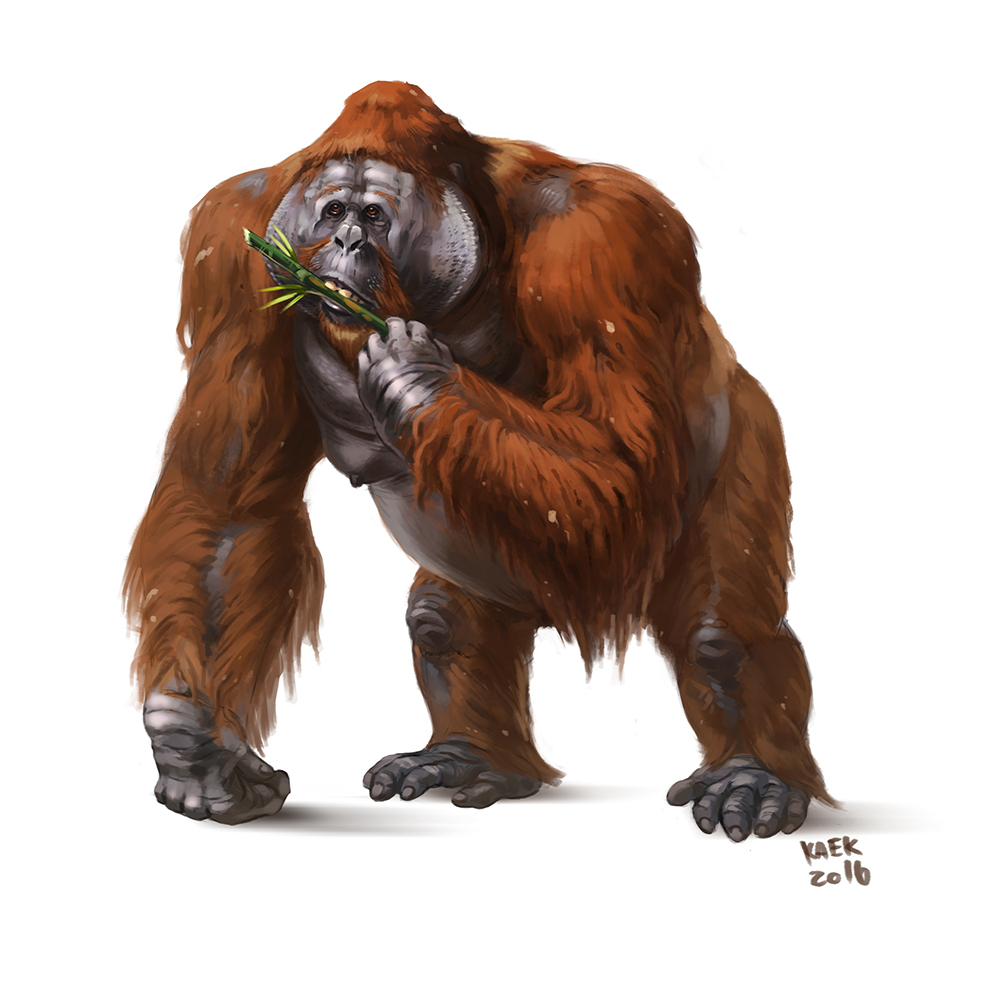
Today's Monster Monday is part III of our month-long series about apes. This week, we're looking at the dire ape, or gigantopithecus. Gigantopithecus stood nearly 10 feet tall at full extension, making it a gigantic hulk of an ape. Older depictions of gigantopithecus often make it look like a giant gorilla, but the closest living relative of this giant Asian ape is actually the orangutan.

Gigantopithecus blacki, by KaekArt, via Wikimedia
We don't have a lot of fossils of gigantopithecus - mostly teeth from caves in China, India, and Vietnam. One thing missing are its pelvic bones, so we don't know for sure whether it walked upright like a human or on all fours like most apes. Given its bulk and the rarity of upright locomotion, it seems most likely that it used its arms and legs to walk, like a gorilla. But that hasn't stopped cryptozoologists from speculating (unfounded speculation is what they do, after all) that relic populations of gigantopithecus are responsible for sightings of sasquatches and yeti. That is, of course, dumb, but it is a gigantopithecus fun fact.

Since I reworked chimpanzees, orangutans, and gorillas, I had to rework the dire ape as well. As previously statted up, the dire ape was a CR 3 monster with 19 Strength. That would make them less powerful than my gorillas. Heck, it puts this giant ape roughly on par with a walrus. So the new dire ape is a CR 6 monster with 23 Strength. It has two slams, a bite attack, and rend. In combat, the gigantopithecus will bring its incredible strength to bear on any attackers, rending them limb from limb.

The following text in gold is available as Open Game Content under the OGL. Open Game Content is ©2018 Jonah Bomgaars.

Monday, March 12, 2018

Return to the Plane of the Apes: Gorilla & Silverback

Today's Monster Monday is part II of our month-long series about apes. This week, we're presenting the gorilla and the silverback. Gorillas are the largest of the apes, though our imaginations often inflate their size. Although gorillas are gentle, intelligent, social animals, they are also territorial. When angered or threatened, they can put their incredible strength to good use, slamming their rivals with their massive arms gouging enemies with their strong, sharp teeth.

Each troop of gorillas is led by a dominant male called a silverback, who is always the largest and strongest of the troop. Most of the time, the silverback is the only male in the troop, though sometimes he has a cadre of adult male warriors at his command, called blackbacks. Because the silverback is so important to gorilla society, and because they are physically more powerful and more dangerous than other gorillas, I thought they deserved their own stat block.

Silverback gorilla. Photo by Pierre Fidenci, via Wikimedia
You may know that the scientific name for the western gorilla is Gorilla gorilla, but do you know where the word gorilla comes from? It is a Greek translation of a Carthaginian Phoenician interpretation of an unknown West African word that may not have even referred to gorillas. According to Herodotus, around 500 BC the Carthaginian explorer Hanno the Navigator sailed down the coast of West Africa, encountering tribes of people, exploring strange islands and lakes, and founding settlements. After passing by a country devastated by forest fires or a volcano, he encountered gorillas:
On the third day after our departure thence, having sailed by those streams of fire, we arrived at a bay called the Southern Horn; at the bottom of which lay an island like the former, having a lake, and in this lake another island, full of savage people, the greater part of whom were women, whose bodies were hairy, and whom our interpreters called Gorillae. Though we pursued the men we could not seize any of them; but all fled from us, escaping over the precipices, and defending themselves with stones. Three women were however taken; but they attacked their conductors with their teeth and hands, and could not be prevailed upon to accompany us. Having killed them, we flayed them, and brought their skins with us to Carthage. 
It is open to debate whether the apes Hanno and his men encountered were gorillas or chimpanzees, or if this incident even occurred, but that is ultimately where we get the name 'gorilla'.

From our first recorded encounter with gorillas (though Hanno's was obviously far from the first encounter), our two species have had a troubled co-existance. Today we recognize the importance of protecting these gentle giants, but past humans - especially past Europeans - haven't been so charitable. In that light, gorillas can certainly serve as a formidable foe in any campaign where they are encountered.

via Bayerische Staatsbibliothek and Wikimedia
Pictured: Almost certainly not how this encounter happened
I should point out that both gorillas and chimpanzees are quadrupedal, rising to their hind legs only rarely. Chimpanzees can move a bit on their hind legs, but gorillas can only rear up. As such, I have given these apes the +4 to CMD vs trip attempts that quadrupedal creatures are entitled to, and that they were not given when they were originally statted up for Pathfinder.

The following text in gold is available as Open Game Content under the OGL. Open Game Content is ©2018 Jonah Bomgaars.

Tuesday, March 6, 2018

Plane of the Apes, Part I: Chimpanzees and Orangutans

I hope y'all like apes, because this month's Monster Mondays are all ape related. I'll explain why in a moment, but first: Today's Monster Monday (yes, I know it's Tuesday) is the chimpanzee and the orangutan. Both of these great apes are intelligent, tool-using forest dwellers. While orangutans are typically loners, chimpanzees have a complex social structure. Chimps will even form hunting parties and sometimes engage in inter-troop warfare.

Orangutan photo by David Arvidsson, via Wikimedia / Chimpanzee photo by Hans Hillewaert, via Wikimedia
At this point, some of you may be wondering, "Hey, but chimpanzees and orangutans are already statted up for Pathfinder. So are gorillas and gigantopitheci, two of the other apes I determined you were going to be profiling either by guessing, reading ahead, or through use of my own psychic powers. So why are you statting them up again?" A fair question. Several months ago, I set out to stat up a man-ape - the sort of monstrous beast that Conan might fight in a rad Frank Frazetta painting or an equally rad but problematically racist Conan short story. In so doing, I checked the pre-existing stat blocks for several apes in order to get a baseline to work off of. What I found was a bit of a mess. According to their stat blocks, chimpanzees and orangutans have 11 Strength - roughly what an average peasant NPC might have. If you know anything about apes, you know this is wrong. Chimps and orangutans have incredibly strong arm muscles. Like Kickpuncher, their punches have the power of kicks. In fact, unless you are pals with Hafþór Júlíus Björnsson, adult chimpanzees are probably stronger than anyone you've ever met. The much stronger gorilla has a Strength score of 15, which you might recognize as the roll you got for your fighter's Strength shortly before the GM let you re-roll.

So I set to work doing what RPG nerds do best - pedantically correcting the products of hard-working professional game designers. I did some research into the strength of apes, the many attempts to measure ape strength compared to humans and the assorted downfalls of such trial methods. I read about how apes defend themselves in the wild, and what parts of their body they use when attacking each other. I looked at Wikipedia and saw that gorillas are usually 4'11"-5'11" tall, putting them squarely in the Medium size category, not Large as they had been statted up. I went to a zoo and stood next to a gorilla and confirmed that no, they are not as big as horses. I took all of this knowledge and used it to give you this wonderful month full of apes.

Next week, we will Return to the Plane of the Apes with the gorilla and silverback gorilla, then we'll journey Beneath the Plane of the Apes to dig up the aptly named gigantopithecus, also known as the Dire Ape. Finally, we'll witness the War for the Plane of the Apes with the terrifying and monstrous Man-Ape. But first, let's look at those stat blocks for the chimpanzee and orangutan.

The following text in gold is available as Open Game Content under the OGL. Open Game Content is ©2018 Jonah Bomgaars.

Monday, January 8, 2018

Monster Monday: Sawfish, A Toothy Sword-Faced Fish

Today's Monster Monday is the sawfish, a large shark with a tooth-lined sword nose that it sweeps back and forth to shred fish. Okay, actually sawfish aren't sharks, they are rays. And their noses (rostra) aren't lined with teeth, they are modified tooth-like scales (dermal denticles). But there are a similar group of saw-nosed sharks, but they are much smaller than the sawfish, which grows up to about 23 feet in length.

Common sawfish (pristis pristis); Photo by David Iliff (License: CC-BY-SA 3.0), via Wikimedia
With that said, sawfish are awesome monsters and I am surprised they haven't appeared in a Bestiary yet. Not only does their saw-nose make for a memorable combat experience, but it can also be fashioned into a macuahuitl. If you are going for a more prehistoric experience, saw-nosed sclerorhynchids lived from about 130-55 million years ago - most were Small-sized like modern saw-nosed sharks, but onchopristis was 26 feet long with an 8 foot saw lined with barbed teeth. There was also the saw-nosed ichthyosaur eurhinosaurus that you can find back in this old post.

The following text in gold is available as Open Game Content under the OGL. Open Game Content is ©2018 Jonah Bomgaars.

Monday, January 1, 2018

Monster Monday: Sivatherium - Dire Giraffe?

Today's Monster Monday is sivatherium, a prehistoric giraffe that had a moose-like head of antlers. Sivatherium was not as long-necked and spindly as modern giraffes. While its neck was rather long, this beast was thicker and stockier, weighing more than the average adult giraffe at around half the height. I guess you could think of it as a condensed giraffe. With antlers.

photo by Hiuppo, via Wikimedia
Sivatherium reconstruction in the Museum of Evolution of Polish Academy of Sciences
The sivatherium ranged across Africa and India during the Pliocene epoch and survived in some areas up until 8,000 years ago. It also had a really cool looking skull:

photo by Ghedoghedo, via Wikimedia
Skull and leg of sivatherium giganteum in the Natural History Museum, London
In a campaign setting, a sivatherium would stand out as an attractive target for a hunt, as it is tall and distinct enough to spot from far away, it is packed with almost a ton of meat, and its skull and hide would make distinctive trophies. It would also be challenging to hunt, as its high vantage point would give it advance warning of approaching enemies, and its long legs and neck would allow it to lash out at attackers with surprising reach.
The following text in gold is available as Open Game Content under the OGL. Open Game Content is ©2018 Jonah Bomgaars.

Monday, December 11, 2017

Monster Monday: Carnotaurus, the Horned Predator

Today's Monster Monday is carnotaurus, a horn-headed giant predatory dinosaur. Carnotaurs was an abelisaurid - a group of bipedal predators from the Late Cretaceous southern hemisphere who had comically small arms - smaller even than a tyrannosaurus rex. I mean, their wimpy little baby arms aren't their defining characteristic, but they are pretty noticeable.

carnotaurus reconstruction by DiBgd, altered by Steveoc 86, via Wikimedia
Little arms aside, carnotaurus was a legitimately terrifying predator. It was one of the fastest of the large theropods, capable of running up to 30 mph. It could also work its toothy mouth very quickly, delivering slashing bites to its prey. There are two main theories about how it hunted - one points to its speed and its almost snake-like jaw to suggest that the carnotaurus chased down and swallowed whole smaller prey. Another theory suggests it would dart into herds of titanosaurs and deliver dozens of quick slashing bites to the giant creature's flanks, letting them bleed out so it could feast on them later. I say: why not both?

Carnotaurus illustration by Lida Xing and Yi Liu, from this article on how carnotaurus was so fast, via Wikimedia
So what about those horns? Most theropods don't have horns like that. In fact, carnotaurus is the only one. They might have used them to ram other carnotauruses in mating displays, like rams do. They might have used them for self-defense against other predators. They might - and this is my favorite theory - have used them to clear a space around a carcass so they could feast, spiking others who tried to horn in on their spot.

In any case, the creature presented below has both bite and gore attacks, it can swallow creatures whole with its bite attack, and deliver a free bull rush attempt with its gore attack. It also has a move speed of 50 ft., the same as a horse, letting easily catch up to a group of adventurers and commence with the biting.

The following text in gold is available as Open Game Content under the OGL. Open Game Content is ©2017 Jonah Bomgaars.

Monday, November 20, 2017

Monster Monday: Dire Eagle, The Largest Bird of Prey

Today's Monster Monday is the dire eagle, or harpagornis. While it is nowhere near as large as the giant eagles of Tolkien's Middle Earth, the harpagornis has the benefit of having actually existed. Not only did it exist, but it lived recently enough to kill and eat humans.

illustration by John Megahan in this article, via Wikimedia
When the Maori arrived in New Zealand in the 13th century, they found a mountainous, forested land full of giant flightless birds - moa - that were really easy to hunt. Then they discovered what ate those birds. It was a huge eagle with a nine foot wingspan. It dropped from the sky with the force of a falling rock, striking its prey with talons spread wider than a man's hand. If that didn't kill the moa, it could slash its neck with a quick nip from its sharp beak. If it took down a young moa, it might even be able to fly off with it.

The Maori soon hunted the moa to extinction, and without their favorite prey the giant eagle went extinct soon after. But the eagles and humans coexisted for over a century, during which time the eagles probably got a chance to try out some new bipedal prey. Maori legends tell of a giant man-eating bird called a pouakai that was large enough to carry a man off in its talons. In one tale, the hero Hau-o-Tawera bested the bird by making a large strong net and having some villagers walk around under it looking tasty. When the pouakai dropped out of the sky on them, it was trapped in the net and they stabbed it with spears.

Today, the giant eagle of New Zealand is called the Haast's Eagle, and its scientific name is Harpagornis, meaning 'grappling hook bird' because of its massive talons.

The following text in gold is available as Open Game Content under the OGL. Open Game Content is ©2017 Jonah Bomgaars.

Monday, November 6, 2017

Monster Monday: Amphicyon, Prehistoric Bear-Dog

Today's Monster Monday is amphicyon, also known as the bear-dog, a prehistoric predator related to both bears and dogs, which had features of each. The largest bear dog species had the size and power of grizzly bears, while smaller bear-dogs acted more like wolves. The bear dog statted up below is somewhere in between - a predator with the bulk and strength of a black bear, but a more wolf-like head and tail.

Reconstruction of the amphicyonid Ysengrinia
from an article by Borja Figueirido, Juan A. Pérez-Claros, Robert M. Hunt, Jr., and Paul Palmqvist, drawing by Óscar San−Isidro, via Wikimedia
Amphicyonids in all their myriad forms roamed across North America, Europe, Asia, and Africa from 46 to 1.8 million years ago. The larger, more bear-like species were probably omnivorous, but ate more meat than modern brown and black bears. The smaller amphicyonid species could be represented by the stat blocks for wolf, dog, or dire racoon, or by applying the young simple template to the stat block below. Giant amphicyonids like amphicyon ingens can be made by applying the giant simple template.

Also, I bet their cub-puppies were adorable.

The following text in gold is available as Open Game Content under the OGL. Open Game Content is ©2017 Jonah Bomgaars.

Monday, October 2, 2017

Monster Monday: Platybelodon, the Shovel-Tusked Elephant

Today's Monster Monday is platybelodon, the weirdest elephant ever. This prehistoric elephant-like creature is distinguished by its four tusks, the lower two forming a shovel-like growth jutting out below the trunk.

Platybelodon sculpture by Sean Cooper & Martin Garratt, photo by RobinGoodfellow_(m) via Flickr
Platybelodon and related amebelodonts were gomphotheres - elephant-like creatures that roamed the earth 12 million years ago up until the end of the last ice age. While most gomphotheres had four tusks, amebelodonts had these specialized shovel-like plates. It was once thought that they used them to literally shovel up their food, but according to recent reconstructions of their life and diet, these creatures used their shovel-tusks to scrape tree bark and even as a saw to cut down small saplings and shrubs while their flexible trunk held them in place.

It also has one of the most terrifying skeletons of any herbivore:

via Wikimedia
The following text in gold is available as Open Game Content under the OGL. Open Game Content is ©2017 Jonah Bomgaars.

Monday, September 25, 2017

Monster Monday: Giant Camel and Two-Humped Camel

Today's Monster Monday is a twofer: both the two-humped camel and the giant camel, two sure-footed pack-animals specialized at living in harsh conditions.

Tang-Dynasty model of a Sogdian riding a camel, via Wikimedia
Modern camels aren't as big as that tiny rider makes this one look, but the scale is about right for someone riding a
prehistoric giant camel like titanotylopus. Also, the rider looks like a lawn gnome, which amuses me.
The two-humped camel is more commonly known as the Bactrian camel, but Bactria is a real place on Earth, so that name is probably not suitable for most fantasy campaign settings. The one-humped dromedary or Arabian camel has already been statted up, but I felt the need to stat up their hardier, stronger, and more wide-ranging two-humped cousins as well. Two-humped camels have higher Strength and Constitution scores, making them ideal for hauling heavier loads in harsher environments than dromedaries, and also making them more formidable in a fight - both of which are characteristics that adventurers in camel-country might want to look for in their mounts and pack animals.

Bactrian camels resting in Jiayu Pass, by Emcc83, via Wikimedia
Prehistoric North America was home to many species of camel, including the gigantic megacamelus, titanotylopus, and gigantocamelus (those last two are considered by some paleontologists to be the same). These giant camels could be roughly 12 feet high and weighed over 5,000 pounds, making them about twice the size of the largest modern camels. In your campaign, giant camels might be employed by wealthy merchants to ship large quantities of goods across the desert, or they might be ridden by desert giant warriors. They could even be used as fighting platforms similar to war-elephants; imagine a giant camel draped in scale barding armor, with two archers firing from its back and two pikemen fighting from armored baskets hanging on either side of the beast.

(Don't forget to check out the encounter ideas and adventure hooks for these camels below the stat blocks!)

The following text in gold is available as Open Game Content under the OGL. Open Game Content is ©2017 Jonah Bomgaars.

Monday, August 14, 2017

Monster Monday: Hagfish - Jawless Slime Eels

Today's Monster Monday is the hagfish, a jawless fish that bites with rasping tooth-plates, ties itself into a knot in order to pull chunks of flesh off its prey, and can turn the water around it into slime. It sounds like the larva of an aboleth or some other primeval aberration, but it is 100% real and 200% gross.

Myxine glutinosa, from Les Poissons (1877) by Gervais and Boulart, via Wikimedia
Hagfish recently made the news when a truckload of them spilled out onto a highway in Oregon, coating the road and nearby cars in thick slime. This reminded me of a note that I made years ago in my ever-growing list of monsters to stat up: 'Giant hagfish that swarm ships.'  Normal hagfish have already been statted up (well, cat-sized versions of normal hagfish), but presented below are 10-foot giant hagfish and a writhing hagfish swarm. If you want to see a real-life hagfish swarm in action, check out this video from the Monterey Bay Aquarium.

A hagfish swarm can pose a danger to adventurers in the water. They might be attracted by a recent kill that the party made, tearing into the flesh of the corpse and the heroes alike. Giant hagfish are even more dangerous, as they can tear open the hull of a ship to get at the food inside. Imagine the horror as the adventurers go belowdecks in a ship only to find it flooded with seawater, slime, and squirming eels feasting on livestock and sailors.

The following text in gold is available as Open Game Content under the OGL. Open Game Content is ©2017 Jonah Bomgaars.

Monday, June 19, 2017

Monster Monday: Colossal Octopus, Tentacle of the Deep

Today's Monster Monday (apologies for missing last week's post) is the colossal octopus, a tremendous being from the inky black depths of the sea, larger even than the legendary kraken. This being is a force of nature; a terror to shipping and to coastal communities.

Drawing by Pierre Dénys de Montfort, via Wikimedia
The kraken is a threat thanks not only to its immense size but also to its cunning (Int 21, Wis 20) and its innate magic. The colossal octopus, on the other hand, is a wholly non-magical animal, but nonetheless a true monster of the seas. With eight tentacle attacks and a powerful bite, this beast is built to take on a whole ship full of adventurers. It clocks in at Challenge Rating 13, which means it is an accessible opponent for more adventuring parties than the CR 18 kraken. The description also includes rules for hacking off its tentacles individually, because how could there not be? I'm actually kind of baffled by how the tentacle chopping that was a part of the kraken's stat block in D&D 3.5 disappeared in the Pathfinder version.

Back in the days of the Enlightenment, as humankind's approach to studying the natural world transitioned from the natural philosophy of earlier times to the more rigorous scientific method, both the kraken and the gigantic octopus were occasionally considered to be real creatures. Carl Linnaeus, the father of the modern taxonomy himself, included the kraken (under the scientific name Microcosmus marinus) in the first edition of Systema Naturae, published in 1735. The French naturalist Pierre Dénys de Montfort included both the kraken and what he described as the larger "poulpe colossal" (colossal octopus) in his 1802 work, Histoire Naturelle Générale et Particulière des Mollusques.

Drawing by Pierre Dénys de Montfort, via Wikimedia
These vestiges of myth and legend were soon scrubbed from scientific literature due to a lack of evidence, but it is worth noting why they ever made it to those pages in the first place. While we may take for granted that creatures like the colossal octopus are pure myth, early naturalists did not have the luxury of such certainty, especially when it came to the mysterious ocean depths. Naturalists used not only their own observations in their descriptions of the natural world, but also reports from others, studiously collecting and analyzing eyewitness accounts, local legends, and the writings of their ancient and medieval fore-bearers. The kraken and colossal octopus were represented in those sources just as the real monsters of the deep were; the fact that the immense carcasses of the otherwise unbelievable giant squid and blue whale occasionally washed ashore only served to lend credence to the idea that these other abyssal titans might exist somewhere out there in the unplumbed depths of the boundless ocean.

The following text in gold is available as Open Game Content under the OGL. Open Game Content is ©2017 Jonah Bomgaars.

Monday, May 22, 2017

Monster Monday: Gallimimus & Ornithomimus - They're Flocking This Way

Today's Monster Monday is a two-for-one deal: ornithomimus and gallimimus, two fast, bipedal dinosaurs that ran around in herds. You may remember gallimimus from this scene in Jurassic Park.  Can a druid have a gallimimus companion and ride it around?  Of course.

Struthiomimus by Nobu Tamura, via Wikimedia
Ornithomimus stands slightly taller than a man, and reaches lengths of 12 feet including its tail.  Gallimimus is much larger, easily reaching 20 feet in length, with some specimens reaching 26 feet.  Together, these two dinosaurs are the most recognizable of a group of dinosaurs called ornithomimosaurs.  These dinosaurs tend to be lightly built, nimble, and very fast - Struthiomimus may have attained speeds of 50 miles per hour.  They are recognizably ostrich-like in shape, with long legs and long necks.  Like many species of dinosaurs, ornithomimosaurs were feathered.  Unlike other more familiar theropods, like tyrannosaurus and velociraptor, ornithomimosaurs were not fierce hunters.  Their diet is still under debate, but it is likely that they were omnivores, snatching up small mammals and reptiles, munching on insects, and pulling soft buds and leaves off of trees.

There are many species of ornithomimosaur.  The stats for ornithomimus work just as well for struthiomimus or archaeornithomimus, while the stats for gallimimus will serve for beishanlong as well.  Smaller ornithomimosaurs like anserimimus, sinornithomimus, pelicanomimus, rativates, and garudimimus can be simulated by applying the Young simple template to the ornithomimus stat block.  The largest ornithomimosaur - the odd-looking but gigantic and terrifying deinocheirus - will require its own unique stat block, but that is a Monster for a different Monday.

 by Nobu Tamura, via Wikimedia
Beishanlong
, a large ornithomimosaur rivaling and perhaps exceeding gallimimus in size.
I went back and forth many times over what size category these dinosaurs should be in.  Strictly by the numbers, ornithomimus is closer to horse-sized than man-sized, and should be a Large creature, while gallimimus is as long as an orca and might belong in the Huge size category.  Ultimately, though, I opted to make ornithomimus a Medium creature and gallimimus Large.  For one thing, without its tail, ornithomimus is roughly the size of an ostrich, which is already statted up as a Medium creature.  The dinosaurs also just aren't very powerful compared to other Large and Huge monsters respectively.  What really convinced me was that making ornithomimus Large would mean it could serve as a mount for Medium creatures.  While very light jockeys can ride ostriches in real life, I can't imagine a scenario involving an armored adventurer getting onto an ornithomimus resulting in anything other than horrible hip injuries for the poor dinosaur; on the other hand I can easily imagine humanoids riding gallimimus - probably because I read Dinotopia so much as a kid.

Ring Riders by the great James Gurney
The following text in gold is available as Open Game Content under the OGL. Open Game Content is ©2017 Jonah Bomgaars.